We are the Axel with Wings translation team, made up of fans of Yuzuru Hanyu. We hope to share videos of him and Japanese figure skating content with more people around the world. We aim to do our best to accurately capture the spirit of what's said. Hope you enjoy our videos and other contents.
We encourage purchase of the original magazine if you have the means, which also features some beautiful photos. Here is a guide to how to purchase the electronic edition for Kindle for international fans.
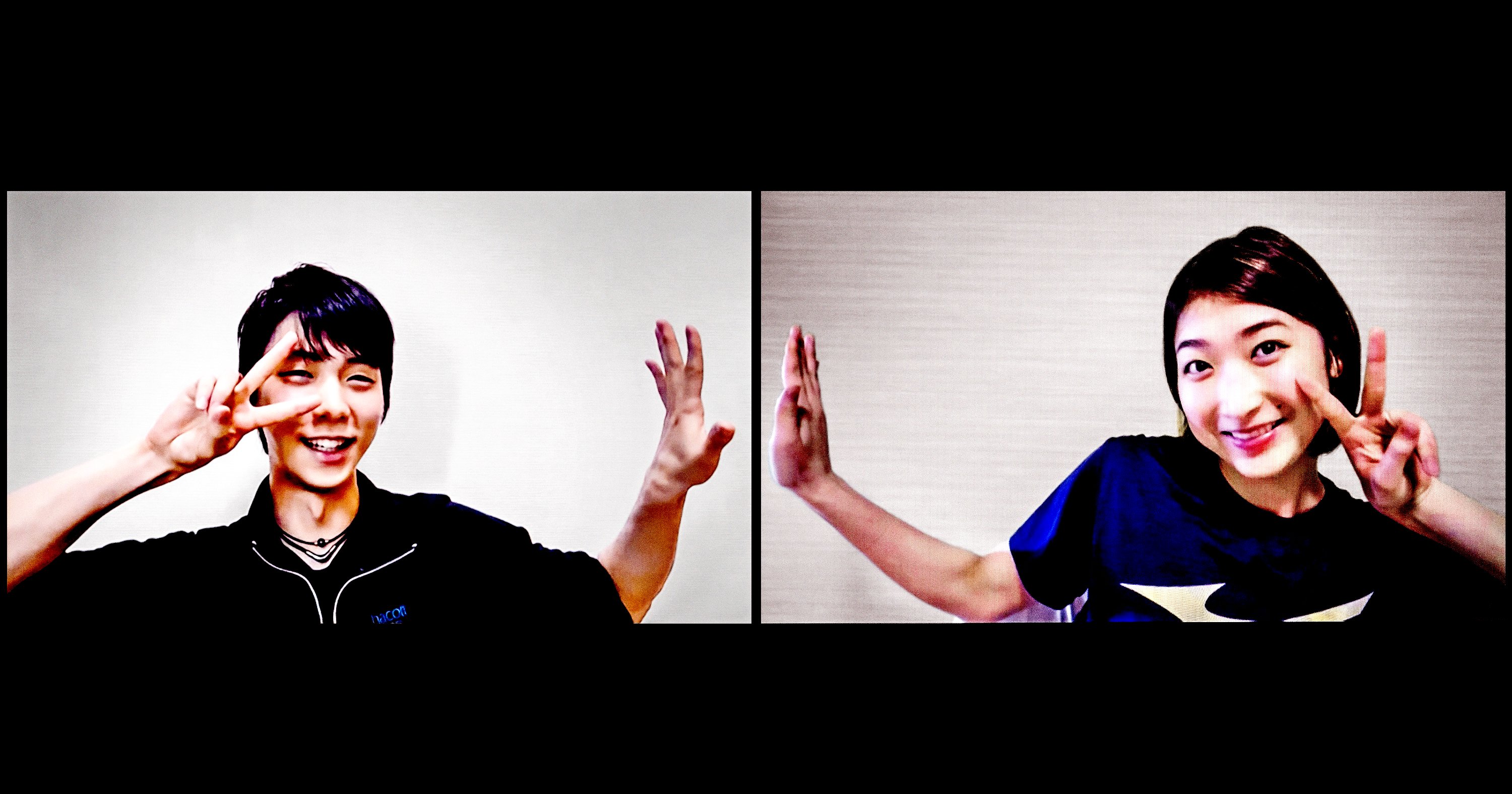
As we draw closer to the Tokyo Olympics, a ‘great exchange’ that connects Tokyo and Sendai took place in this special Pre-Olympics Numbers edition.
今夏、再び祭典の場に姿を現す水泳の申し子、池江璃花子と、冬の王者、羽生結弦の初顔合わせである。
This is the first face-to-face meeting between the golden child of swimming, who has once more taken to the competitive stage, Rikako Ikee, and the champion of Winter, Yuzuru Hanyu.
From the outset of the conversation, he showed his concern for Ikee, saying, ‘I’ve felt this whole time that though she’s young, she’s had to shoulder the weight of various things and has worked really hard. Of course, there was dealing with her own illness*, but also wanting to give courage to others who were also sick and wanting to get better, all of those things. While I feel that she doesn’t have to bear all of that weight, it’s perhaps because she’s carried these burdens that she is strong.’
*Ikee was diagnosed with leukemia at 19yrs old in February 2019.
Ikee replied: ‘It’s true that I’m carrying the knowledge that I shouldn’t shoulder these burdens. After recovering, I’ve felt at all races that I’m almost like a representative for those who have been ill.’
Hanyu: “I think at the time, it weighed on me very heavily.”
The worry of the illness and the recovery last year. Ikee, who seemed to recover and return as a competitor in the blink of an eye, had been shouldering burdens unbeknownst to others. From afar, Hanyu could sympathise with this. It’s because even now, he has also been shouldering a heavy weight that fate had laid upon him.
“Even now, I try wherever possible to accept requests to help out with [financial] support and recovery in the affected region, but at the time I thought of it as an incredibly heavy weight. The natural disaster suddenly happened and then when it was thought that I was chosen to be the representative of Japan [in figure skating] only because I was someone doing my best in the affected disaster area, I felt very frustrated.”
Though she was initially a little tense and nervous in front of the two-time Winter Olympic champion, through a combination of the kindness, warmth and especially strength conveyed through Hanyu’s words to her, Ikee also was able to open up.
In addition, the conversation topics included how to prepare for the Olympics, recent and past frustrations and regrets, times when they cried alone, and how to overcome those difficulties now. It’s because they are both top athletes that they could trade notes on all these topics.
いつまでも聞いていたい、珠玉の対談だった。
It’s a gem of a conversation you’d want to listen to, anywhere and anytime.
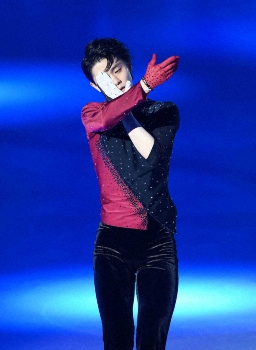
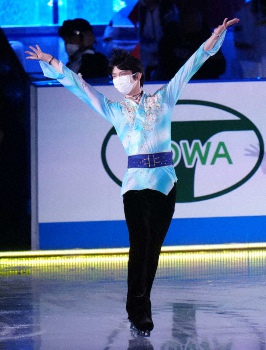
The ice show “Dreams on Ice” was held on the 9th at Kose Shin-Yokohama Skate Center in Yokohama. Sochi ‘14 and Pyeongchang ‘18 gold medalist Yuzuru Hanyu (ANA) took part for the first time in six years, unveiling his program “Masquerade,” starting off a new season. The interview questions with him are as follows.
― (Your thoughts on) This being your first appearance at DOI in six years.
Yuzuru: Um, well, I strongly felt that I wanted to skate in front of everyone. Last year there weren’t ice shows, and so I wanted to skate more in front of an audience. Also, last season when I participated in competitions, I thought that perhaps my performances could be useful for someone; that perhaps they could feel something from it. So with that in mind, I wanted to try for everyone’s sake. I want to take the opportunity to skate in as many places as possible, so I decided to participate in Dreams on Ice this time.
Y: Of course, I personally received a lot [of power]. I received it and then changed it into power for my performance, and maybe everyone watching will pass this on in turn in another form. I’m already exhausted after this one performance so I hope this may be the impetus for some sort of emotion in everyone.
― What is the current state of the quad Axel, which you cited as your ultimate goal right now?
Y: Firstly, Dreams on Ice is the first ice show in awhile where I’ve had to do two performances in one day. I thought that I must prepare my body and focus on this ice show so I haven’t been able to practise my quad Axel until now. After Stars on Ice, there was the toll that it took on my body, the need to take care of my body that had worked hard last season, there was practice on the foundations of the axel, and the need to do the work to properly rebuild my body for the quad Axel from square one; I’d like to start concretely practising for the season ahead from here on out.
――今季のプログラム、SPは決まったか。
「曲は決まっている。ただ、実際に音源はできていないですし。まだ発表できません」
― Regarding next season’s programs, have you decided on your SP?
Y: The music is decided. But, the editing is not done, so I cannot announce it yet.
――フリーは継続か。
「はい、フリーは『天と地と』を継続したいなというふうに思います」
― Will the free program [from last season] continue on?
Y: Yes, I am thinking I want to keep the free (program) “Ten to Chi to”.
― What is the reason you decided to compete in the GP Series again after two seasons?
Yuzuru: Without the chance to be in competition, I think even if I land the quad Axel, it’s pointless. I strongly feel I want to land it in competition. I thought that I should take as many opportunities as I can in that regard, and so I decided to participate in the Grand Prix series [this season].
― You decided on NHK Trophy and Rostelecom Cup [for your GP competitions]
Y: When they decided I would compete at the NHK Trophy, I felt it would definitely be either Rostelecom Cup, Skate Canada or the Cup of China. I was 3rd at the World Championships so I didn’t have any particular say in it.
―Once again, what are your thoughts on the Beijing Olympics?
Y: I don’t particularly have the same feelings that I absolutely must get the gold medal like I did during the season of Pyeongchang (Olympics). However, I am very determined to definitely land the quad Axel this season. I will take up that challenge this season with that resolve and determination.
― Is [the Beijing Olympics] something beyond that goal?
Y: If it happens to be part of the journey [towards the 4A]. It’s just…hm. Like I said before, I feel I don’t have the same degree of passion or fervour that I did at the time of Sochi or Pyeongchang.
― What is the reason you performed “Masquerade” today?
Y: Well, I haven’t had many chances to perform this program. But also, since that time [I first did the program], I’ve become more of an adult, and I think there is more I want to express, and given the current state of the world, there is more I think that can be objectively felt from the program, so with those thoughts in mind, I wanted to perform it again, so I chose this program.
― Will your training base this season be in Japan?
Y: First, in order to return to Canada now, there are many difficult procedures involved. I’m not certain whether it is even possible or not, but for the time being, based on my experiences from last season, I feel that I can grow even if training on my own, so I am not thinking of returning to Canada at the moment. However, I think with regards to the choreography, that it will be done with remote assistance [from Canada].
― The upcoming Tokyo Olympics has been decided to be held without spectators. How do you feel about this?
Y: I am coming from the standpoint of an athlete. To put it bluntly, the audience…in regards to whether the audience can convey their support or travel [to watch] in person, I can’t really speak to that. But if I can speak from an athlete’s standpoint, the Olympics are a dream stage for many athletes, I think the final dream stage they long for the most. I don’t think the fact they will give everything they have on that stage will change. It’s the fact that it’s during times like this – we [skaters] call it a ‘performance’ – but I think it’s precisely because it’s during these [difficult] times that [watching events like] races and whatnot can result in something touching and emotional.
Men’s single skater Yuzuru Hanyu (ANA) gave an online interview before his exhibition appearance. After his last competition of the season, he spoke for about 10 minutes and answered each question as follows.
―What did you gain/learn this season? And what do you still need to work on now that the season is over?
Yuzuru: Hmm… this might become a little abstract. Well, the first time I came in third place at the World Championships was just about nine years ago now. Once again, I was thinking the same kind of things I thought at the time, as it is the 10 year anniversary of 3.11 now. The reason for this is that this time, there were things like the period of self-isolation [because of the pandemic], and also I withdrew from competitions. While I was doing those things, and watching the news, I felt how bad the COVID situation is, and I spent the time wondering about various things like, how we are supposed to confront it, and how people are each suffering in different ways during this time. Somehow, from there… Hmm. I still think the best way to deal with it is to have zero cases if possible, after all. But, (since that’s not possible), we have to keep going, and we have to face and deal with many things. In a way, for me, it’s not about my 4A, but that I feel I need to challenge myself and that I need to put together the best plan of action. Ah, my answer is becoming a little hard to follow. Let me see… In this context, I think about when I was coming up with my own comments on the 10th anniversary of 3.11. How painful was it? What kind of pain was it? Or, how many really want to remember it? Surely there are those who don’t want to be reminded of it, and I was thinking about all these various things. And I thought to myself, “Isn’t this the same as the current situation with COVID?,” and so ultimately, I came to a conclusion, in the season that 3.11 happened, and the season after it as well. I was much, much younger at the time. I didn’t want to be a representative of the disaster-stricken area, and I didn’t want to be labelled as such because I was a member of the Japanese national team, and I had won the spot with my own abilities. I was thinking strongly then, that I wanted to win various things on my own. But in the end, I began to feel a great sense of gratitude, and I realized that I was the one who was being supported by the people, and that I was not in a position to support them, but rather they were supporting me. I was able to feel those things again this time. Somehow…hm. This became a bit of a rambling answer. As a result of everything, I felt that maybe it’s okay for me to keep skating. If I can find some kind of meaning in my skating, I think that’s a sign that it’s okay for me to exist.
―What was the significance of practising your 4A in practice and your response?
Yuzuru: I totally didn’t expect the audience to be there. After the Free Skate, there was the fact my body wasn’t that tired. I thought maybe it would be worthwhile to do it at the competition venue. The other reason is that I think I’ll be going back to training alone and I think it’s easier to get a better mental picture jumping it when you’re motivated by the presence of other really talented athletes. But when I actually tried it, the jump was nowhere near my best attempts so I’m really frustrated. I have better ones, really! Truthfully I think I’m closer [that that]. But um, to tell you the truth I’m really really frustrated because I couldn’t do a good jump. So using that frustration as a springboard, though it looks like it’ll be a tough period ahead, I’ll really make intense preparations and analyse various things with a cooler head, and I want to keep pushing past my limits.
―During yesterday’s practice, when you two-footed the double Axel landing, you said, ‘That’s good.’
Y: From the beginning yesterday, my jumps didn’t [feel as] light. The rotations were totally insufficient and I kept jumping 4As that felt off to me. When I popped it into a double Axel at the end, I thought I was finally starting to get a feel of the ice. Finally I was getting the height so I told myself, ‘now rotate it’. After all, if it gets too high, your body instinctively tries to protect itself. It’s also a jump where it’s indeed difficult to balance both the height and rotation, so that comment I made was tied to that [fact] as well.
―Next season, your Free Skate Program will be ‘Ten to Chi to,’ but will you return to a piano piece for your Short Program?
Y: Ummm. To tell you the truth, I’m thinking about it. It’s not just about wanting to go back to a piano piece. I think this program [Let Me Entertain You] was created because of the current situation. You could say it was created precisely because I wanted to do this kind of program that suited the current circumstances. I have to consider how the circumstances will pan out and also how my own feelings will change with it. Also, beyond just doing the skating, I think I’ll pick the program thinking about what I want to express.
―The 4A is hard on your body, so how will you take care of it while you can’t go to Canada?
Yuzuru: Well, for the time being, I am thoroughly taking care of it myself. And there are a lot of people who can help me as well. There is also a lot of information available on the Internet. I’d like to take care of myself to the best of my ability by accumulating various kinds of knowledge.
Y: We’ll only know next season when next season comes. [Seems to be distracted by something else]. Just, um… hehe…. Sorry. We’ll only know about next season when it comes, so there’s nothing I can do about it. Um, well…. Hmmm… hehehe, I can’t. I got a little distracted, for a moment. Hmmm. I’ll think about [next season] when it’s time. I’m sorry!
―At that time, we would like to have the opportunity to speak with you again.
Y: Hehehe… But yes, I will. When I’m asked for comments again, I’ll try my best to come up with different words from my head. That’s something…. Well, I’m not a professional with words and I’d rather express myself with skating, so I hope I can find a way to do that.
―You said you go back and forth between the ice rink and the home, but how do you spend your time at home?
Y: Let’s see. Well… When I’m at home… (first thing) is waking up. Hehehe… I wake up in the morning, um, and then immediately clean*. Then, until food is ready, I’ll do things like image training, checking my form, and so on. After eating, I do some care for my body. I go to practice, come home, take a bath, do some care, eat, then sleep… that’s the kind of schedule I have.
Y: Ah, I do play video games. I’m addicted to Monster Hunter right now. (The one that just came out?) Yes. Yes, I’m playing it. Thank you very much. I was able to say something a little like [what you’d find] in a sports magazine. Hehehe.
(Interview over.)
Thank you very much. and I look forward to working with you again. I’ll do my best.
Yuzuru: Well, of course there are feelings of frustration in there but well, after the World Championships and for these two weeks, I wasn’t living my usual routine, to be honest. In terms of my feelings and well, I couldn’t eat the meals I normally eat, so I’d like to say to myself that I did well, given all those circumstances.
Y: I think everyone was the light. This time, during the Short Program and Free Program as well, seeing the scores like ‘ah, that was really tough but we worked hard’ ―I felt that watching my teammates’ performances as well. In a sense, like a guiding light, they really really gave me a lot of power. As a senior [in the team], I really felt I had to work hard and in a way, it was a competition where I received a different kind of power to the norm.
―How did you try to express (the image of) Uesugi Kenshin* in your (free) program? Y: Hmm, first, I tried to really consider how I wanted to perform the program, like what kind of theme I wanted to perform. So, as a result of listening to many different pieces of music, I thought that in a sense, a theme that would let me be myself would be good. And what I found fitting that (theme) was this piece of music, and I think I myself have a lot in common with Lord Uesugi Kenshin too. Also, various things about him such as his approach towards battle, his (acknowledgement of) sacrifices that must accompany it, and also his compassion and generosity and so on―I think that that is the kind of person, and the kind of athlete that I want to be, and so I chose this program. Um, as for the choreography, there are parts where I am wielding a katana [sword], and also signaling [to soldiers] to move out for battle, but, well, I think it’s up to everyone watching to interpret it as they will. I think this is a program that really is open to what you think, and I am certainly also skating with the thought that if everyone watching could feel a sense or story or something like a scene from my expression of each part of the choreography and each jump, I would be very happy.
*T/N: Referring to 16th century/medieval Japanese warlord Uesugi Kenshin who ruled over part of northern Japan. The music for Yuzuru’s free program this time is taken from a 1969 taiga (historical) drama called “Heaven and Earth” that is about Kenshin’s life.
―(Question from foreign media) Did you have any problems with your asthma this week? Will there be any problems with your asthma going into the Beijing Olympics?
Y: (In English) Hehe. I’m not thinking about the Beijing Olympics. I think it will be good if the Tokyo Olympics happen this year. (In Japanese) Ah. Sorry, please wait a moment. Hehehehee. OK. Um. (In English) I don’t have problems with asthma and my condition going into this competition wasn’t an issue. In regards to performance, I have confidence in both my programs. There was a small mistake in the Short Program. In today’s Free Skate, there was a big mistake on the 4S, but I’m not despairing over the preparations I’ve done until now. I think I’ll need to practise more and more from here on out.
Y: I was really careful going into it. Eh… well, I think my form wasn’t bad but well, I guess you could call it bad luck. I jumped straight into the hole I had made [before]. This is probably a unique quirk that I can’t really do much about, but I do tend to jump in the same spot, more than [people normally do]. So I do tend to snag [my jumps] in the same holes. That’s what happened this time. Honestly, it was just the width of the edge [of my blade]. It was… I wonder how many centimetres it was. Well, it was just a groove around the width of an edge, but I really just got stuck properly in it. (Was it a hole from the 6min warmup?) I think it was.
Y: Um. Well firstly, between the last two competitions, I wasn’t able to land my triple Axels well, which you could say was a big shock, or source of frustration. I really feel hugely apologetic towards my triple Axel. So today, until the very very end ―though of course I had the memories from the World Championships to contend with― I thought I will absolutely land it beautifully. I went into the 3A wanting to show that this is the base from which I’m continuing my road to the quadruple Axel. Within the tiredness [at that point] and with such a slow speed―well, I slowed down on purpose there, as a part of the performance. But within all of that, feeling no strength left, I think I entered the rotation very smoothly and it was a good jump with good height. I think it was the best triple Axel I can do at the moment.
―This was your last skate of the season. What are your feelings about that and also towards next season?
Of course, I really wanted to skate a Free Skate like the one I did at the start of the season.* But unlike before the Japanese National Championships, I went into this one like I did at the World Championships without doing much practice for competition. This time also, after the World Championships, I wasn’t always in a good condition. Well, there was stress and exhaustion and my stomach was also upset. In the midst of various things and ah, well, there was also a mistake caused by bad luck there I think… But I was able to stay with the program until the very end and unlike the World Championships, I really was feeling the music in this program, and feeling everyone’s heartbeats, breaths and prayers, so in a sense I’m satisfied. And then…what was it. Regarding next season? Looking at next season, well, in a sense I think it was a huge shame that I wasn’t able to put in the 4A this season. But it’s because I have been practising my 4A that I was able to discover things like a connection with the music that you saw, the difference between the 4A and 3A, and the ways to think about how to use my body for other jumps. So I’d like to gather my current knowledge, experience and various things and aim for the 4A next season and work hard towards the perfect performance that incorporates the 4A.
*Referring to his Japanese Nationals 2020 performance.
―What did you gain from this competition and what will you work on?
Y: Um, well, to make sure I don’t get caught in a hole [in the ice] that I made myself, it’s a matter of jumping in a different spot. But, so far I’ve tried that many times too, and it didn’t work. I think ultimately my strength is being able to be extremely precise in following what I believe. Like, instead of being able to jump (something) 90% of the time, I can control it so I can jump it 100% of the time. I think that connects to having clean jumps and (high) GOE, like yesterday’s (quad) Salchow [in the short program]. So, I think I want to diligently hone in on this strength. As for what I gained this time, there’s a lot I need to work on, but, maybe it’s that I landed a [triple] Axel nicely for the first time in a while. To be honest, there were a lot of things, like the (quad) Loop wasn’t perfect either, and the (quad) Toe Loop and combination were a little off as well, but above all, I was able to get into put my heart and soul into this program, and the last [triple] Axel was exhilarating, and for the first time in a while, it was something that felt like one of my usual Axels. The short (program) was what it was and the (quad) Salchow there was good too. I think now I have the feeling that somehow for the first time in a while I was able to jump like myself. Thank you very much.
Yuzuru Hanyu, attending his first WTT after sitting out of the last competition, secured second place with a season’s best of 107.12, and afterwards participated in an online interview.
―You did a peace sign to the supporting teammate area [after your performance]
Yuzuru: Um, well, the announcements are all happening in Japanese, so internally I wasn’t going to listen to them. Ah, but I ended up hearing that [teammate Shoma] Uno’s score wasn’t that good. I was nervous, and although he made some mistakes, I think that I was able to feel some sort of spirit or power from him which let me do my best.
Y: I was trying not to worry about it too much. I think that what I can do to contribute the most right now is to properly get into my performance and do it at my own pace. However, today, until the very end, I think I was able to skate by kind of borrowing some energy from alongside [Shoma] Uno.
Y: Hmm~ Well, I think I did what I could. I’m not paying too much mind to the placements. But um, as for myself, not regarding the team competition aspect, it was the first time I was able to land a nice (quad) Salchow and (quad) toe loop [4T3T combination] jump in the first half of this program in competition, so I feel like I’ve made progress.
―What are your thoughts heading into the free program?
Y: Umm… well, I do have a considerable amount of what you could call feelings of frustration or the desire to redeem myself from the World Championships. I want to acknowledge those feelings and then on top of that, would like to concentrate properly on delivering a performance like I did today where I can really feel that I’ve grown.
―There was an earthquake not too long ago [in Sendai], how did it affect you?
Y: Hm. Firstly there was the earthquake that happened in March, but the earthquake in February affected where I was living more. The things on our shelves and the shelves themselves were shaking really badly and well, tableware broke and there was damage like that around the house. But, fortunately, there weren’t injuries or damaged windows, or damage to the building itself ―though I suppose there may have been some cracks― and there wasn’t anything as severe as the 3/11 disaster. But Ice Rink Sendai did experience cracks [in the building] and the wall that had been damaged in the 3/11 disaster collapsed once again. There was damage everywhere, just like from 3/11. Fortunately the ice wasn’t broken, nor was the cooling system. Thanks to the special efforts and consideration of Ice Rink Sendai ―though it wasn’t immediately as they couldn’t do it in a day and it was while repairs were going on― I was able to skate just a little from the following day onwards.
―What was the motivation for making you think that you could leave behind something with your programs this time?
Y: Um, the most impactful thing for me was that when I was returning to Japan from Sweden on my sponsored ANA flight, there was really no one on board. The airport was also completely dark. I saw this state of the airport, and it’s what people overseas would be calling a “ghost town.” What was supposed to be a boarding gate had been turned into something like a… hospital reception area. When I saw these circumstances, I thought that it was really important for me to refrain from spreading the virus myself. I also strongly felt that I must not become a reason for others moving [travelling] and possibly spreading the virus, [and because of that] I sat out the Grand Prix series [last fall]. Of course I still hold those feelings, but I am also fully aware that there are those who have lost their usual means of work, those who are suffering during these circumstances, and of course, how difficult it is for those involved to organize and run a competition like this, which includes TV staff and reporters who came here. I thought that by bringing myself to this venue that [people depend on for] work, I could um, maybe help in someway. Also, the ANA staff who guided me at the airport and took care of me, I had said they couldn’t say congratulations to me, but rather they said things like “I really received courage [from you],” and that they felt empowered from my performances. Although of course I still have complicated feelings, it was based upon weighing these [conflicting stances] that I made my decision to appear [at WTT]. Thank you very much. I look forward to speaking again tomorrow.