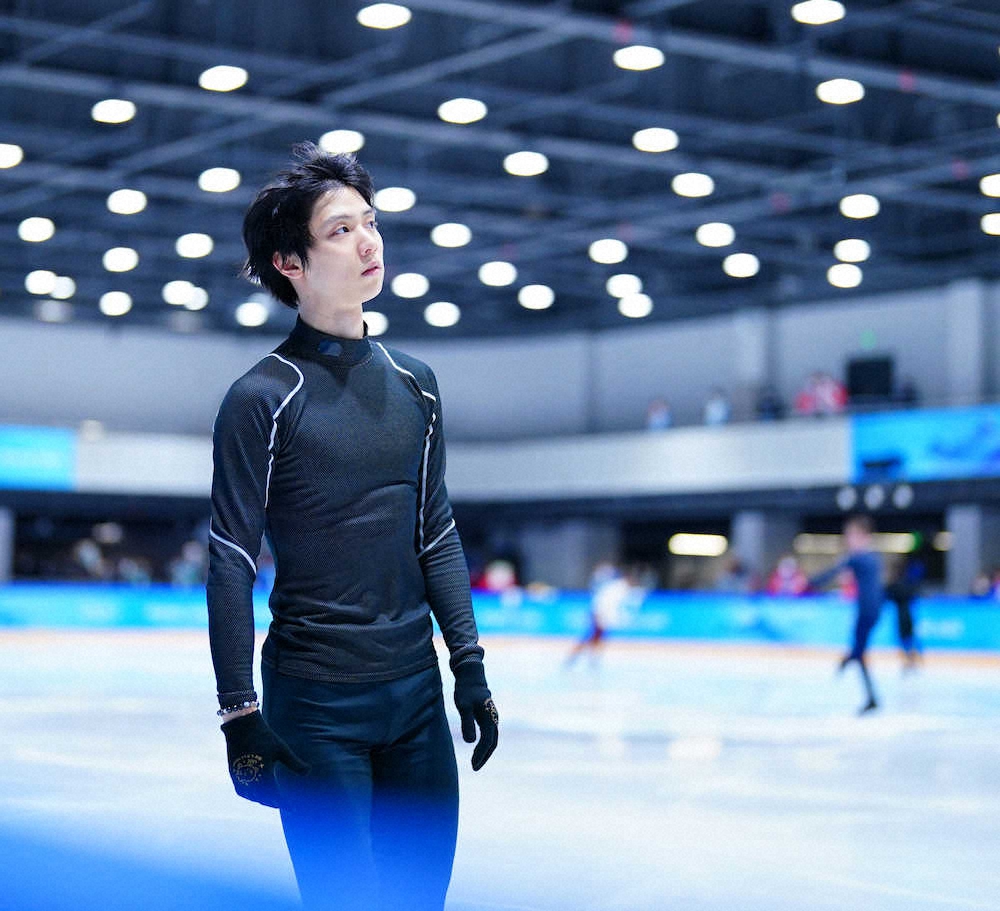
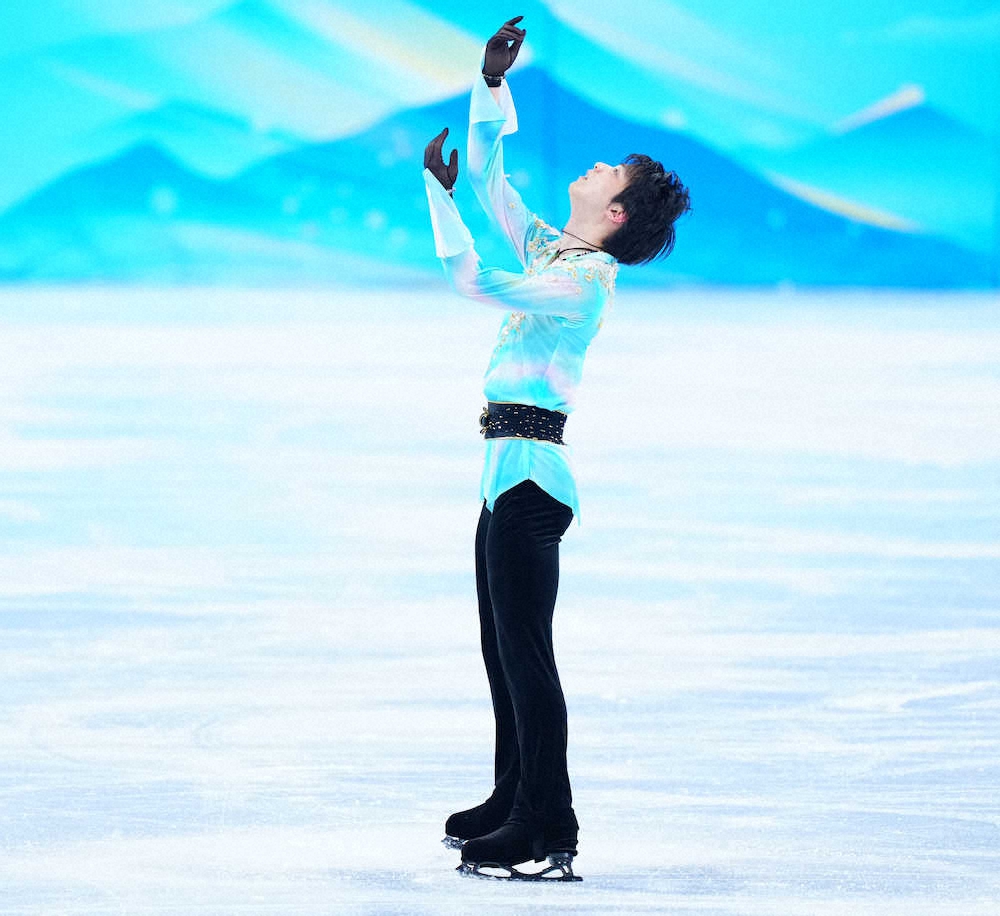
Y: Rather than get stuck… it’s more like… um, when I say I got stuck, I mean that I got stuck in a hole that I traced before, which is what happened in 2019 in a short program. The mistake in that Short Program in 2019 was probably because um, during the 6 minute warm-up, I was fixed on my jumping position down to the millimeter, and I ended up jumping in the same spot later [in the actual competition]. This time, I was already aware of that past mistake, and I had that experience in my mind. So, during the 6 minute warm-up this time, I adjusted my position a little bit. And so, during the actual program, I went in with the perfect form and the perfect timing for the jump, and the moment I tried to take off, there was a hole there. It was a hole from a toe jump. So there’s nothing I could do about it.
――朝に初めて本番リンクを滑った。調整方法を振り返って
Q: You skated in the main rink for the first time this morning. Looking back on your preparation method, what are your thoughts?
Y: Well, it was pretty good, if anything. The 6-minute warm-up was also really good. I also felt really good about my physical condition. Well, of course, facing the Free Skate, I’d like to stay in this good condition. Today’s mistake was something that I couldn’t have prevented, no matter what I did. Well, looking ahead towards the Free Skate, I want to properly put everything I have into it.
――サルコーの後はどんな気持ちで滑ったのか
Q: How did you feel when skating after the [quad] Salchow?
Y: Well… kind of like, “well, that happened”. In any case, to my senses, that kind of thing wasn’t a mistake to me. So, I think that’s why I was able to continue on with the program without it affecting my mind at all.
――今日は感情を抑えていたのか
Q: Were you able to refocus your feelings [after the mistake] today?
Y: Rather than refocus my feelings [after the mistake], how do I put it… it’s like when you see something, and with just one small piece coming out of place, I wasn’t quite able to bring it all together. It is what it is, yes.
Y: Well, I’m really thankful to be even getting 95 points with [that kind of error]. I think that’s because I was able to complete the other elements with high quality and I’d like to commend myself for that. How to put it. Well… truthfully speaking, I wondered if I had done something bad. Hahaha. Like somehow…was it because I had done something bad that it turned out this way? It was the sort of mistake where I could only think about that kind of thing, yes.
Photo by Yoshiki Kogaito, Sponichi
PART 2
――ここは五輪という強い気持ちはあったか
Q: Did you have any strong sense of this being ‘the Olympics’?
Y: Of course I had. Well, the atmosphere was different from usual [competitions]. Um. But I was really in a super concentrated state, in a condition where there was nothing out of place, so if I try to search for the cause of the mistake, I won’t be able to sort them out. I don’t think there were any mistakes with the skating element. It’s like… I wonder if I did something to be hated (laughs), like I skated while thinking I must be really hated by the ice.
――2日前に入った理由を
Q: What was the reason behind you arriving 2 days before [the SP]?
Y: Um… for me personally, since I became a Senior skater, I’ve felt that the longer I stay [at a competition], the more I become listless, and my condition gradually worsens. Things like the World Championships are also long [events] but if I do things for too long, then I get into the competitive mindset too much, and tire out. When the Team Event members were announced, that was when I decided I would cut it close [in arriving].
――初めてSP首位でない順位でフリーを迎える
Q: You’ll be heading into the Free Skate not as the leader of the Short Program for the first time (at the Olympics)
Y: Well, (at the time of the interview) the starting order hasn’t been decided yet so I can’t really say anything but, well, I can only do my best in the free program, yes.
――(英語で)4Aはフリーで跳ぶのか、成功できるか
Q: [In English] Will you jump a 4A in the free? Can you land it?
Y: [in English] I think I can do it. I know this jump is difficult for me. I must focus on every aspect, and going forward, I want to give my best in everything.
――10日にどんな「天と地と」をみせたいか
Q: What kind of performance of “Ten to Chi to” do you want to show on the 10th [day of the free program]?
Y: Well, hopefully one in which I don’t get caught in the ice [laughs]. Rather than the saying “one good deed a day”*, I’m wondering if I now have to do like ten good deeds a day [to avoid this happening again] (laughs). But, I think I’ve done enough practice to justify that much. I think I’ve come here with a lot of confidence in my performances. As for the rest, well, maybe only God knows. In any case, there’s still time. Also, by making good use of the time after the short program [until the free], and really taking in everyone’s feelings, I want to turn my performance into something complete. Thank you for having me. Thank you, I’ll do my best [in the free program].
*T/N: Referring to a Japanese proverb, 「一日一善 」 “[doing] one good deed a day”
A: Thank you for your hard work! U~m, I was really able to concentrate, I think. Of course, I was more nervous at the start, eh… but I was kind of trying to adjust to the feel of the ice. I think I was able to internally adjust, little by little, and ultimately was able to focus while practising. I think it was a good feeling.
Y: Well, of course… um, I think my condition changes every day, and also, this is the first practice after arriving so I feel like I’m not doing it with all my strength yet. But little by little, I hope I’ll make some improvements even here (at the Olympics)..
Q: What have you been putting your efforts into since the Japanese National Championships?
Y: Well, indeed, I’ve been practising the 4A. Well, I practised it while thinking that it’s really hard. However, it is, after all, the goal I want to achieve no matter what. Well, for me personally, I think it’s absolutely necessary for me to rise to the top at this Olympics. I’ll do my best.
Q: This being your third Olympics, what’s different from the past ones?
Y: Well. In all the previous Olympics, I went in thinking something like if I just put out what I had been practising and doing up until then, I’d be able to win. But this time, I’m in a position where I still have to up my level. In a sense, it’s similar to [what I said] at Japanese Nationals but, I think the tension of a stage such as the Olympics is indeed something unique.
Y: Hm~ I haven’t yet. Anyway, um, since I’ve come here I’ve been feeling pretty good, and today I was able to practice while feeling that my rotations were coming pretty easily. First and foremost, I want to rotate [the jump] fully.
――団体戦の刺激は
「ああ、うーんと、刺激というよりも、リンク凄く良さそうだなあと思ってちょっと安心してました」
Q: What was motivating about the team competition?
Y: Ah, um, well rather than encouraging, I felt relieved thinking that the rink seemed to be in good shape.
Y: The Short Program? Hehehe. The Short…well. Of course, I’m thinking rationally about it, and I end up thinking a lot about the 4A. But the Short Program is the Short Program. I’d like to really pour a lot of love into the Short… um…yes, one by one, I’d like to accumulate everything I can, heading into the Short Program
*T/N: The original article said 4A4A but we think it was a typo
Q (In English): [Brian] Orser is not by the rink with you
Y: Ah – um, I will answer in Japanese. Um. Brain, Ghislain [Briand] and Tracy [Wilson] are properly watching over me. This time, they themselves said that they’d like to respect my routine.
Yuzuru Hanyu has his hand on the door of history’s first quadruple Axel. He challenged it for the first time in competition at the Japanese National Championships 2021. Though [the 4A] was judged to be of insufficient rotation, he showed that he was closing in on the ‘truth of rotations’. And then there is one other person, a human who has taken on this world of ‘4.5’. The person who is the leading expert on ‘twisting’, who has landed a 4.5 twist in practice, Kenzo Shirai. Shirai spoke about the 4A from the viewpoint of achieving such ‘rotations’. revolutions.
Hanyu-senshu is currently challenging the world of the quadruple Axel. I’d like to ask you about the possibility of the 4A through the angle of rotations
I’m watching Hanyu-senshu’s 4A challenge with bated breath. What both gymnastics and figure skating have in common is the question of how you create the twist (horizontal rotation) and how you control it, so I’m thinking about various things from the perspective of a gymnast while watching.
During your competitive days, you had 6 eponymous ‘Shirai’ skills. There was the 3.5 twist, the quad twist, which were all high speed rotation skills that overturned the common understanding at the time. In the world of gymnastics, horizontal rotation is known as ‘twisting’ but does it have points in common with figure skating’s quadruple jumps?
In the case of gymnastics, we use both vertical rotation and twisting (horizontal rotation) but we have a leg and arm that establishes the axis and allows us to control rotations which is the same [as figure skating]. In addition, as the number of revolutions increases, I think the thinking around ‘how do we create more rotations’ is similar. I twist to the right (clockwise direction) so my right arm is my ‘axis’ arm. Hanyu-senshu’s jump just happens to go in the opposite direction. I think the theory behind rotation is something gymnastics and figure skating have in common.
Also in terms of the aerial position, your type is one where you cross your legs, which is very similar to skating. What kind of impact does the air position have on the skill?
The air position and positioning of the arm varies depending on the athlete. Some athletes don’t cross their legs. There are athletes who bring in their elbows in order to narrow their axis and athletes who stretch their elbows out to help regain balance. The air position and positioning of the hands and face in figure skating is also different depending on the athlete. Hanyu-senshu jumps with his elbows spread outwards so he might be the type who does so to balance his rotational axis. If he draws in his arms, the rotational axis becomes narrower but the axis is more prone to instability. The balance between the speed of rotation and the axis differs between athletes.
In any case with Hanyu-senshu, his rotation itself is beautiful and his axis isn’t shaky – that’s something you can tell even from his air position, isn’t it?
I have this impression that, before the Axel, Hanyu-senshu keeps his head still and then jumps. In gymnastics also, when you’re connecting skills, if your head moves, you may not be able to enter the rotations in an ideal way, so the positioning of the head is important. Maintaining the position of my head from the start to the end of the skill was my forte as well. Having said that, even though ‘you must not move your head’ is the theory up until doing quad (twists), when it comes to challenging the 4.5 twist, you are to move your head.
Actually I heard you have succeeded at doing a 4.5 twist in practice. What kind of difference in technique exists between the quad twist and 4.5 twist?
Up to doing the quad twists, I tried not to move my head and the right shoulder that I was using to lead into the movement since I was focusing on the axis. I’ve learned since childhood to do it that way since the rotational axis is important for being able to land. But when it was time for the 4.5 twist, I didn’t have time to focus on my axis. When I put 4.5 revolutions in the air and then thought about how densely the movement was packed, there was not enough time no matter what I did. Up until the quad twist, first I’d establish an axis after jumping up and then have time to start twisting, but for the 4.5 twist, I couldn’t make it unless I condensed the time I took to establish the axis. And if I were to describe how I did it, it was that from the moment I jumped, I’d start twisting both my leading right shoulder and my head in the direction of rotation.
――幼少期から習ってきた方法を変えるのは、発想の転換でもあり、勇気も必要ですね。
To change the method of training that you were taught since childhood requires a change in thinking and courage doesn’t it?
Of course. When I was taking on the 4.5 twist, I tried various things that failed. At first, I was trying the method of ‘rotating a quad and then adding a half rotation after’ but even when I established a good axis and tried rotating 4.5 times, I couldn’t complete the rotation in time no matter what I did and fell sideways on the landing. It was the equivalent of a step out in figure skating. It was when I changed the approach to start rotating the same moment I took off that I landed it for the first time. Based on what I’ve deeply felt in my experiences until now, the more you feel like you have a really good swing (on takeoff) or establish a good axis, the less you can achieve the new skill. You only succeed at it when the internal feeling is closer to an ‘oh shit’ level of strangeness.
On top of that, I was still a high school student when I succeeded at the 4.5 twist so I didn’t have any muscles yet and had not increased the height of my somersault. Therefore, it wasn’t increasing the height or air time but thinking about how much I could compress the movements into my rotations that allowed me to succeed. Of course, I think you can’t succeed if you don’t get sufficient height, but I think there’s a way to succeed at “4.5” without having the height and airtime.
I’d like to ask you about whether there’s a possibility the 4.5 twist and the 4A are connected. Firstly, in the case of Hanyu-senshu’s 4A, he’s rotating in the opposite direction so he needs to open his left shoulder, doesn’t he?
The foundations of gymnastics and figure skating are different so this is talk from an amateur’s point of view, but for Hanyu-senshu, my impression is that he opens his left shoulder and leads the rotation with his right arm. For the triple axel, at the moment of takeoff, he doesn’t open his left shoulder and jumps towards his right arm, which he raises forward. The moment he raises his right leg, he keeps the rotational axis around his right side while trying not to open his left shoulder. With this method, he’s only creating the rotation using his right arm. However, if he opens his left shoulder and starts the rotation from there, he might be able to get more rotational power.
――左肩から回転を起こしたら、右側の回転軸に移れないイメージですが、いかがでしょう?
If you start rotation from the left shoulder, there’s this feeling you won’t be able to shift to the right rotational axis – what do you think about that?
I think it’s fine if you only use the left shoulder at the start. Open it up at the start and create power for the rotation from there, try to shorten the time between takeoff and opening the shoulder and then catch up to your left shoulder with your right shoulder soon after. The method is that you’re not starting by creating an axis with your right side, but instead, you start rotating first with your left shoulder and add in the rotational axis with your right shoulder.
――強い回転が生まれるイメージは分かりました。軸の作り方がかなり変わりますね。
I can picture how you can generate strong rotational strength. It does indeed change the method of how to create the axis.
In my case, when doing the “4.5”, my way of thinking was not ‘create an axis first’ but rather ‘fix the axis I created at the time at the point of landing’. After I’m in the air, I’ve already let it go. If, while in the air, I got the sense of ‘this is where my axis is’, then I was able to decide how to position my feet when I landed. If I created the axis in the air or tried to fix it, I couldn’t ensure I completed all 4.5 revolutions.
――体操は両足着地ですが、スケートは片足着氷なので、着氷で直す難しさもあります。
You land on both feet in gymnastics but because you land on one foot in skating, fixing (the axis) on landing is difficult.
In Hanyu-senshu’s case, he’s very good at using his hip joint. In the Free Skate at the Pyeongchang Olympics, in the final 3Lz, he was able to land with one foot when his head was low. Being able to react like that in that instant is something other athletes can’t do and is Hanyu-senshu’s strength. Therefore, if Hanyu-senshu himself can understand this idea that ‘I can respond by landing in this wide variety of ways at the moment of touchdown’, I think he may be able to lighten the degree of focus on the axis. If you think only that you must establish the axis, you may be late to enter the rotation, or you can’t put enough power in the takeoff and there are various kinds of effects from that. If you think about just taking off and rotating as you imagine and then think about how you can recover the axis on landing, you may be able to find a different kind of balance. If it’s Hanyu, he definitely has the ability to respond that way.
――理論的には可能な気がしてきました。でもアクセルのセオリーと違いすぎて、驚きのアイデアです。
I feel that it’s possible theoretically but it’s so different from the theory for jumping the Axel that it’s a shocking idea.
In the same way as you’re taught to not open your left shoulder going into the Axel, we’re also taught from childhood in gymnastics too that you should not open your shoulder when you do the twists. [Opening the shoulder] isn’t something you do normally, but what you’re attempting isn’t ordinary. I think if you don’t also do something out of the ordinary with your technique, you probably can’t achieve the 4A. Because there is a textbook way to jump, everyone can do the 3A. But for the 4A, Hanyu-senshu has to write a new textbook. I think he can do it.
――普通ではない技術。羽生選手なら“普通”の概念をうちやぶる力があると思います。
A technique that is out of the ordinary. I think Hanyu-senshu has the power to overturn this concept of “the usual”.
It’s a skill no one has done before, so any method is the correct answer. Therefore it’s an even more simple principle. For techniques everyone can already do, judges/referees also understand it so, in a sense, they have a ‘preferred’ method of execution. But for new skills, the correct way is how the person who completes it does it. Therefore, the way Hanyu-senshu executes it would become the ‘correct’ way to do the 4A. He’s challenging a world no one has reached yet. I will cheer for him!
Yuzuru: I think I decided that I would aim for a third Olympic win when the team selection ended, after I was selected as a representative [for Team Japan] and I received this jersey*, around when I was about to attend the press conference. When I put my arm through this jersey, it was like “Ah, this is the Olympics.” But, since I already have attained two consecutive wins, the thought of losing that is certainly scary. As it is right now, I think the chances of me losing are, without a doubt, higher than they were at Pyeongchang [2018]. But when I put on this uniform, it made me think “I’m going for the win, I have to win.”
*T/N: Referring to Team Japan Olympic team jacket
――大谷翔平の活躍はどう見ているか
Q: Have you been following Shohei Ohtani’s activities?
Shohei Ohtani, baseball player; often referred to as Yuzu’s contemporary due to their age (both are born in 1994) and similar athletic excellence
Y: To be honest, it’s kind of thought that in figure skating, a skater’s prime is around age 23 or 24. But if you look at something like baseball, you may hear that an athlete really gets into their peak around their 30s, early 30s. So I wonder if it is ok to really say we are of the same generation, but, seeing an athlete my age doing all of that, maintaining what is perhaps his best shape ever, and also having to go through difficulties related to surgery, and then breaking new, unprecedented territories [in his sport], that really encouraged me. Challenging the quad Axel is perhaps also still in a world of the unknown to me, but in a sense, [watching Ohtani] really gives me a lot of courage.
――自分で描いていた4回転半成功へのスケジュールは
Q: What is your envisioned schedule to succeed at the 4A?
Y: To be honest, after Pyeongchang [Olympics], I thought I’d be able to land it in the following season. Hahaha. That’s how much confidence I had in my Axel jumps, and also the lack of awareness I had about how truly difficult the quad Axel is. However, ultimately, various things happened, like injuries and whatnot, so there were times I couldn’t really focus on the quad Axel. The more I tried to focus on the quad Axel, the more injuries would follow. And the more I focused on it, the more keenly I’ve realized how hard it is to rotate more than a quad. I think that’s what these four years have taught me. In fact, I’m going for a quad and half turn now, but it’s only recently that I’ve been able to get my axis [right] like this, so it’s been really tough.
――4回転半は一日何本までと決めているのか
Q: How many quad Axels do you allow yourself to do per day?
Y: Ah, well, it’s not like I decide on a specific number to do. However, it depends on my physical condition at that time, so of course, there are some days that I decide it’s ok to not do any quad Axels. Still, [on those days] I’d think about how I should practice the triple Axel for the sake of the quad Axel. Then I’d think about how many triple Axels I should jump that day, or if there’s something that can give me the same feeling with a quad jump, even if it’s not the quad Axel, then I’d think about how many quad jumps I should put in after the triple Axel.
Photo by Kogaito, Sponichi
Part 2
――羽生選手が思う言葉の力は Q: What do you think about the power of words?
Y: Uhm, I’ve been competing for a long time until now, and I’ve always wanted to accomplish what I say. Therefore, in a sense, I use my words as chains and pressure. Because of them, I always think that I definitely want to accomplish [what I said]. I think it’s probably thanks to such words that I can accomplish so much without giving up.
――言葉にすることで自分が勇気づけられる面もあるのか
Q: Does saying things out loud also give you encouragement?
Y: In my case, rather than giving me encouragement, it’s more accurate to say that it allows me to organize my feelings and the plans I have in mind. Also, things like how I feel when doing the jumps; because I say these things out loud, it often allows me to arrange [my thoughts] and results in good things.
――どうしてジャージーを着た時に3連覇へ切り替わったのか
Q: Why did you change [your goal] to a three-peat [at the Olympics] after wearing the [Team Japan] jersey?
Y: Yes…well, as I’ve said in yesterday’s conference – it was an [on-the-spot] interview in a box though – I’m frustrated. I spoke about it being close to ‘q’ or around the point where it could be called ‘q’ but I couldn’t jump [a jump that was close to q]. I guess there was the fear of somehow letting it end there. I also felt like I’m somehow betraying those who said that I could jump it. I don’t know if they were saying that I must be the one to do it but since there are people who are saying that I can do it, I feel like I’d be betraying them somehow if I gave up and didn’t try it. So in coming to the Japanese National Championships, I feel that I must not give up on it here, I suppose. I feel that I must commit to trying it until the Beijing Olympics. The other thing is that the Olympics are not a place where you try things out, it is after all a place where you must win. To me, that is. I also achieved two consecutive victories so I absolutely do not want to let that go. Precisely because of that, I’ve realized that I absolutely want to win, with renewed determination.
――今のままでは勝てないと言っていた、どうしたら勝てるか
Q: You said that you can’t win as you are now, so how will you be able to win?
Y: Well, to put it simply, I want a competitive layout where I’ll be able to properly get +GOE on the 4A. Honestly speaking, I think a layout incorporating the 4A and the 4Lz or 4Lo is unrealistic. Furthermore, in the month or so that I have left, I think what I can do is probably just the Axel. I want to properly train on the [quad] Axel. Also, in regards to the Short Program, there are many places that still aren’t perfect. [I want them to be as perfect as] the Salchow was, to the point where I can think ‘that was good’. So apart from [the Salchow] – though I don’t know whether I’ll be able to earn more points – I want to train nonstop.
――体の衰えを感じていると言っていたが、どんどんうまくなっているように見える
Q: You’ve spoken about your body deteriorating [with age] but it looks as though it’s getting better and better.
Y: Um, well, yes, when I was about 24-25 years old, there was a period where I really felt like my growth had stopped, indeed, where I felt like I had lost the ability to complete a Free Skate. But as I said, I’m probably at my best now. Without doubt. It’s likely because I was able to establish my own training method. I was able to plan it myself. Being able to establish and implement a figure skating training regime tailored to myself was possibly the most significant thing, I think.
Q: You said at the GPF two years ago that your ideal ‘Yuzuru Hanyu’ was when you were nine years old. Is that still the case today? Without that kind of innocent confidence, would you be able to face the quad Axel?
Y: My strong point at that time was that I could win. So, yes, if you were to ask me if my emotional approach back then would work against the 4A, I’d say not really. The confidence that I had back then, like I could win no matter what, I don’t know how to put it… When it comes to winning, I think [that confidence] is what you need the most. But the reason why I could have such confidence was because I was practicing the best I could back then. I thought I was practicing more than anyone else. I was able to practice while thinking that I was better than anybody. The Olympics is where that kind of thing is even more necessary. So of course, I want to practice hard on everything, including the (quad) Axel. And I think I was the strongest when I was 9. Well, the word “strongest” is a bit mixed up with what I said earlier. I am definitely the strongest now in terms of technical ability. But mentally, I feel that I was the strongest and brightest back then. Therefore, I want to cherish the person I was back then.
―4回転半のアプローチがちょっと違うというのは
Q: What do you mean by saying the approach to the 4A is a little different?
Y: It’s not a jump that you can do based on mere confidence. Hehehe. The fact it’s not a jump that you can just naively and recklessly force yourself into jumping is something that I’ve come to believe after these four years of throwing myself at it. Therefore, the ability to strategize and calculate the finest of details is important to succeed at the 4A. In regards to that, my present self is better without doubt [than before/his approach when he was 9yrs old].
――昨年は体重を増やしていた。今年は減らしているのか、体のアプローチは
Q: Last year, you were gaining weight [on purpose]. Have you slimmed down this year? What’s your approach to your physical condition?
No, I didn’t intend to slim down but I also didn’t plan to put on weight. You could say I’m kind of in the middle of it. Um, to be honest, I wanted to be a little slimmer going into the Japanese Nationals. Like maybe it would be good to be a little lighter. However, if I compare it to last year’s weight, yes, if we talk about [the time of] Japanese Nationals, it’s about 2kg. Ah, maybe not 2kg, maybe 1kg lighter. I’m about 3kg lighter than I was at the World Championships [2021] and World Team Trophy. I’m not sure which one is better. It’s just that I haven’t figured out which is best.
――長らく仙台で調整してきた。故郷で過ごした感想。ケガのときは何が心の支えだったか
Q: You have been training in Sendai for a long time now. How do you feel about spending time in your hometown? What gave you emotional support when you were injured?
Y: Well, I’ve been in Saitama and I have also gone to many places for competitions, but in the end, Sendai’s landscape is the one that remains in my heart. Of course, there are things like urban development and places that are changing quickly, but even if the only thing there is nostalgia, you could say it makes me feel relieved. I’ve gotten used to a really warm feeling. Um. Well, of course there were tough periods when I was injured and a large part of my life has consisted of things like hurting due to injuries, not having a rink and being unable to train. I’ve truly been through that kind of pain multiple times. But…hm. Somehow, to live this way now, to talk in front of everyone, to perform for someone somewhere to watch and feel some sort of emotions from it, I think those moments are truly wonderful. Right now, I’d like to always feel the happiness that stems from those things.
――今後も仙台で調整するのか
Q: Do you plan to continue training in Sendai after this?
「そうですね、仙台で頑張ります。たぶん。たぶん?(笑い)」
Yes, I will work hard in Sendai. Maybe. Maybe? (laughs)
――取材が終了
(End of the interview)
「すいません、ありがとうございました。またよろしくお願いします、みなさん」
Thank you very much. I ask for your support again, everyone!
Yuzuru: I was tired. Um, with the 4A included, my run-through, well, even though it wasn’t a complete run-through, I was able to practice to the same extent as last year, I think personally I’ve completed about 60% of the training, so I feel like it wasn’t up to par. But as expected, [the 4A] puts a burden on the body to the point where you can’t really compare it to the 4Lo.
Y: Well, in the morning practice, I wasn’t really expecting that I could rotate it. In any case, the actual competition was most important. I practised with the intent to rotate it properly there. However, I was really unable to jump it, so I was somewhat despairing. Um, up until the actual competition, I was really frazzled. Well, with all those things in mind, I felt once again that it’s really difficult to be trying a jump in competition that I hadn’t landed decisively yet.
Y: Well, I think I did what I could. On the first day, when everyone saw that Axel, they were probably thinking ‘Ah, Hanyu’s Axel has really improved’. Actually, it was only able to improve to that extent in the last two weeks. Until that point, I was just constantly throwing myself into it, couldn’t create my axis and the rotations were also getting more and more insufficient. I was slamming my body against the ice over and over again, and doing jumps that seemed like they were going to kill me. Somehow, the jump eventually came to take shape. But it’s not something I can do every day. Therefore, while I think everyone might be feeling something like ‘oh, he’s almost landing it, isn’t he?’, the truth is that there’s still a lot to do, even to get there. How tough it is to create the axis, to have the confidence to create the proper axis, then you know it’s impossible unless you rotate the thing 100%. Well, if I were to be able to do that in competition, right now, I think there are places I can compromise on [for those considerations]. Even though I’m frustrated/kuyashii about it.
――五輪でも挑戦は続けるのか
Q: Will you continue to work on it for the Olympics?
Y: To tell you the truth, the output was worse before the NHK Trophy, but I was finally able to land the jump without falling before the NHK Trophy. And then, just as I thought ‘oh, I can stand on it’, I sprained my ankle the next day. With the sprain, various kinds of stress piled up and then I developed esophagitis, a fever and various other things. I was truly unable to do anything at all for a whole month. During that time, I thought maybe I should give up. I’d gotten this far. It had taken form. I wasn’t falling on it anymore. Therefore, even before arriving at these Japanese Nationals, although [the jump] got better than [before] the NHK Trophy,… how to best put it. Honestly, I thought this should probably be okay, that maybe it would be okay even if I gave up at this point.
Y: Um, I was really happy to receive so many comments from everyone like ‘this is something only Hanyu can do’ and ‘if it’s Hanyu, he can do it’, but I really felt inside that I was at my limit. So I was feeling like well, this is fine as it is. I worried and agonised about it a lot. There’s a part of me that says “Just a little more… since I’ve come this far, I do want to land it!’. So, well, I may cause a great deal of worry or bother for everyone, but I will push myself just a little bit more.
Photo by Kogaito, Sponichi
Part 2
――2週間前までぶっ飛ばしていて、ここまで来るのにきっかけがあったのか
Q: You were throwing yourself at the jump until about 2 weeks ago, did getting to this point serve as a catalyst in any way?
Y: I’ve been establishing a training method little by little. I was able to do various things, for example: realizing I need to train a certain way for this particular purpose, and another way for a different purpose. I feel like finally, these little ones* are solidifying little by little. After all, even if you understand something, it’s not something you can do immediately, just like that. As I thought, it’s completely different from the 3A. I think I have to keep gathering more and more information, even from here on out.
*T/N: Affectionate way he refers to his jumps as his “children” or “little ones”
――辞めちゃおうと思ってから、ここまで戻ってくるきっかけは
Q: What was the thing that made you return from thoughts of quitting?
Y: This will be a long answer, is that okay? Shall I shorten it? Well, to be honest, I am indeed a little frantic. I know there’s the fact that if I don’t jump it soon, my body is going to decline gradually. But there’s no doubt I’m behind the time limit that I set for myself, so there’s also the pain of wondering why I’m this far from jumping it. And along with that kind of pain is the question of ‘well, if I’ve done this much and still can’t do it, is there the need to do it?’, that kind of thing. There were definitely things that tempted me to give up. But ultimately, on the last day of training before coming to the Japanese Nationals, I jumped and fell on about 4 attempts that would be judged as ‘q’. At the time, after giving much consideration, I realized that I didn’t want to give up on it at Nationals. Since I’ve come this far, since it’s everyone’s dream, the dream that everyone is betting on me for, I thought I want to fulfil it for everyone — well of course for myself, but also for everyone.
――死ににいくような練習とは、今はどれくらいの本数を跳んでいるのか
Q: When you speak of practice that feels like it’s going to kill you, how many jumps do you think you’ve attempted now?
Y: I wonder how many. I haven’t thought about it myself. But I do currently limit my attempts per day. However, even though I limit the number of times I try the 4A, I jump the triple Axel and single Axel as practice for the quad Axel…well, I jumped them many times in the public practice this time. I’ve done those kinds of practices single-mindedly dozens of times. And then… the mental aspect plays a huge part in this but no one has jumped this jump before, and you could also say it feels like no one is even capable of doing it. So in order to find the process to be able to accomplish it, it truly is like you’re walking intently alone in the dark. Therefore, each time, I’m practicing [so intensely] while thinking I might hit my head, fall over, and die from a concussion or something*, yes.
[To Shoma Uno who was waiting for his turn to be interviewed] — Shoma, sorry!
*T/N: Our interpretation is that this is Yuzu expanding on his answer in Part 1 where he was talking about the toll it took on him to be falling on the jump over and over again; it’s his way of describing the difficulty of training the 4A and a fear he had, rather than a real incident.