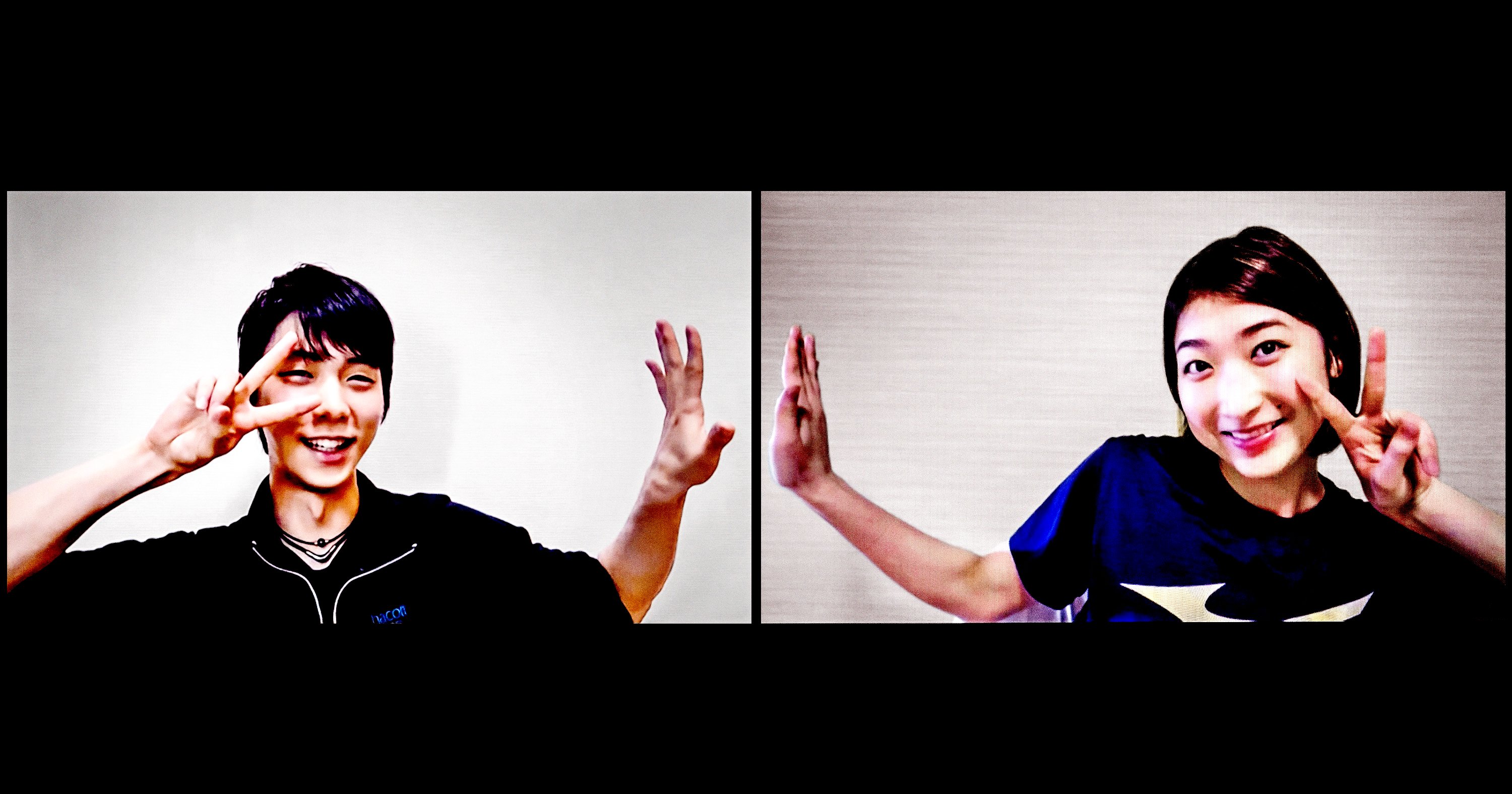
As we draw closer to the Tokyo Olympics, a ‘great exchange’ that connects Tokyo and Sendai took place in this special Pre-Olympics Numbers edition.
今夏、再び祭典の場に姿を現す水泳の申し子、池江璃花子と、冬の王者、羽生結弦の初顔合わせである。
This is the first face-to-face meeting between the golden child of swimming, who has once more taken to the competitive stage, Rikako Ikee, and the champion of Winter, Yuzuru Hanyu.
From the outset of the conversation, he showed his concern for Ikee, saying, ‘I’ve felt this whole time that though she’s young, she’s had to shoulder the weight of various things and has worked really hard. Of course, there was dealing with her own illness*, but also wanting to give courage to others who were also sick and wanting to get better, all of those things. While I feel that she doesn’t have to bear all of that weight, it’s perhaps because she’s carried these burdens that she is strong.’
*Ikee was diagnosed with leukemia at 19yrs old in February 2019.
Ikee replied: ‘It’s true that I’m carrying the knowledge that I shouldn’t shoulder these burdens. After recovering, I’ve felt at all races that I’m almost like a representative for those who have been ill.’
Hanyu: “I think at the time, it weighed on me very heavily.”
The worry of the illness and the recovery last year. Ikee, who seemed to recover and return as a competitor in the blink of an eye, had been shouldering burdens unbeknownst to others. From afar, Hanyu could sympathise with this. It’s because even now, he has also been shouldering a heavy weight that fate had laid upon him.
“Even now, I try wherever possible to accept requests to help out with [financial] support and recovery in the affected region, but at the time I thought of it as an incredibly heavy weight. The natural disaster suddenly happened and then when it was thought that I was chosen to be the representative of Japan [in figure skating] only because I was someone doing my best in the affected disaster area, I felt very frustrated.”
Though she was initially a little tense and nervous in front of the two-time Winter Olympic champion, through a combination of the kindness, warmth and especially strength conveyed through Hanyu’s words to her, Ikee also was able to open up.
In addition, the conversation topics included how to prepare for the Olympics, recent and past frustrations and regrets, times when they cried alone, and how to overcome those difficulties now. It’s because they are both top athletes that they could trade notes on all these topics.
いつまでも聞いていたい、珠玉の対談だった。
It’s a gem of a conversation you’d want to listen to, anywhere and anytime.
The ice show “Dreams on Ice” was held on the 9th at Kose Shin-Yokohama Skate Center in Yokohama. Sochi ‘14 and Pyeongchang ‘18 gold medalist Yuzuru Hanyu (ANA) took part for the first time in six years, unveiling his program “Masquerade,” starting off a new season. The interview questions with him are as follows.
― (Your thoughts on) This being your first appearance at DOI in six years.
Yuzuru: Um, well, I strongly felt that I wanted to skate in front of everyone. Last year there weren’t ice shows, and so I wanted to skate more in front of an audience. Also, last season when I participated in competitions, I thought that perhaps my performances could be useful for someone; that perhaps they could feel something from it. So with that in mind, I wanted to try for everyone’s sake. I want to take the opportunity to skate in as many places as possible, so I decided to participate in Dreams on Ice this time.
Y: Of course, I personally received a lot [of power]. I received it and then changed it into power for my performance, and maybe everyone watching will pass this on in turn in another form. I’m already exhausted after this one performance so I hope this may be the impetus for some sort of emotion in everyone.
― What is the current state of the quad Axel, which you cited as your ultimate goal right now?
Y: Firstly, Dreams on Ice is the first ice show in awhile where I’ve had to do two performances in one day. I thought that I must prepare my body and focus on this ice show so I haven’t been able to practise my quad Axel until now. After Stars on Ice, there was the toll that it took on my body, the need to take care of my body that had worked hard last season, there was practice on the foundations of the axel, and the need to do the work to properly rebuild my body for the quad Axel from square one; I’d like to start concretely practising for the season ahead from here on out.
――今季のプログラム、SPは決まったか。
「曲は決まっている。ただ、実際に音源はできていないですし。まだ発表できません」
― Regarding next season’s programs, have you decided on your SP?
Y: The music is decided. But, the editing is not done, so I cannot announce it yet.
――フリーは継続か。
「はい、フリーは『天と地と』を継続したいなというふうに思います」
― Will the free program [from last season] continue on?
Y: Yes, I am thinking I want to keep the free (program) “Ten to Chi to”.
― What is the reason you decided to compete in the GP Series again after two seasons?
Yuzuru: Without the chance to be in competition, I think even if I land the quad Axel, it’s pointless. I strongly feel I want to land it in competition. I thought that I should take as many opportunities as I can in that regard, and so I decided to participate in the Grand Prix series [this season].
― You decided on NHK Trophy and Rostelecom Cup [for your GP competitions]
Y: When they decided I would compete at the NHK Trophy, I felt it would definitely be either Rostelecom Cup, Skate Canada or the Cup of China. I was 3rd at the World Championships so I didn’t have any particular say in it.
―Once again, what are your thoughts on the Beijing Olympics?
Y: I don’t particularly have the same feelings that I absolutely must get the gold medal like I did during the season of Pyeongchang (Olympics). However, I am very determined to definitely land the quad Axel this season. I will take up that challenge this season with that resolve and determination.
― Is [the Beijing Olympics] something beyond that goal?
Y: If it happens to be part of the journey [towards the 4A]. It’s just…hm. Like I said before, I feel I don’t have the same degree of passion or fervour that I did at the time of Sochi or Pyeongchang.
― What is the reason you performed “Masquerade” today?
Y: Well, I haven’t had many chances to perform this program. But also, since that time [I first did the program], I’ve become more of an adult, and I think there is more I want to express, and given the current state of the world, there is more I think that can be objectively felt from the program, so with those thoughts in mind, I wanted to perform it again, so I chose this program.
― Will your training base this season be in Japan?
Y: First, in order to return to Canada now, there are many difficult procedures involved. I’m not certain whether it is even possible or not, but for the time being, based on my experiences from last season, I feel that I can grow even if training on my own, so I am not thinking of returning to Canada at the moment. However, I think with regards to the choreography, that it will be done with remote assistance [from Canada].
― The upcoming Tokyo Olympics has been decided to be held without spectators. How do you feel about this?
Y: I am coming from the standpoint of an athlete. To put it bluntly, the audience…in regards to whether the audience can convey their support or travel [to watch] in person, I can’t really speak to that. But if I can speak from an athlete’s standpoint, the Olympics are a dream stage for many athletes, I think the final dream stage they long for the most. I don’t think the fact they will give everything they have on that stage will change. It’s the fact that it’s during times like this – we [skaters] call it a ‘performance’ – but I think it’s precisely because it’s during these [difficult] times that [watching events like] races and whatnot can result in something touching and emotional.
Yuzuru: Well, of course there are feelings of frustration in there but well, after the World Championships and for these two weeks, I wasn’t living my usual routine, to be honest. In terms of my feelings and well, I couldn’t eat the meals I normally eat, so I’d like to say to myself that I did well, given all those circumstances.
Y: I think everyone was the light. This time, during the Short Program and Free Program as well, seeing the scores like ‘ah, that was really tough but we worked hard’ ―I felt that watching my teammates’ performances as well. In a sense, like a guiding light, they really really gave me a lot of power. As a senior [in the team], I really felt I had to work hard and in a way, it was a competition where I received a different kind of power to the norm.
―How did you try to express (the image of) Uesugi Kenshin* in your (free) program? Y: Hmm, first, I tried to really consider how I wanted to perform the program, like what kind of theme I wanted to perform. So, as a result of listening to many different pieces of music, I thought that in a sense, a theme that would let me be myself would be good. And what I found fitting that (theme) was this piece of music, and I think I myself have a lot in common with Lord Uesugi Kenshin too. Also, various things about him such as his approach towards battle, his (acknowledgement of) sacrifices that must accompany it, and also his compassion and generosity and so on―I think that that is the kind of person, and the kind of athlete that I want to be, and so I chose this program. Um, as for the choreography, there are parts where I am wielding a katana [sword], and also signaling [to soldiers] to move out for battle, but, well, I think it’s up to everyone watching to interpret it as they will. I think this is a program that really is open to what you think, and I am certainly also skating with the thought that if everyone watching could feel a sense or story or something like a scene from my expression of each part of the choreography and each jump, I would be very happy.
*T/N: Referring to 16th century/medieval Japanese warlord Uesugi Kenshin who ruled over part of northern Japan. The music for Yuzuru’s free program this time is taken from a 1969 taiga (historical) drama called “Heaven and Earth” that is about Kenshin’s life.
―(Question from foreign media) Did you have any problems with your asthma this week? Will there be any problems with your asthma going into the Beijing Olympics?
Y: (In English) Hehe. I’m not thinking about the Beijing Olympics. I think it will be good if the Tokyo Olympics happen this year. (In Japanese) Ah. Sorry, please wait a moment. Hehehehee. OK. Um. (In English) I don’t have problems with asthma and my condition going into this competition wasn’t an issue. In regards to performance, I have confidence in both my programs. There was a small mistake in the Short Program. In today’s Free Skate, there was a big mistake on the 4S, but I’m not despairing over the preparations I’ve done until now. I think I’ll need to practise more and more from here on out.
Y: I was really careful going into it. Eh… well, I think my form wasn’t bad but well, I guess you could call it bad luck. I jumped straight into the hole I had made [before]. This is probably a unique quirk that I can’t really do much about, but I do tend to jump in the same spot, more than [people normally do]. So I do tend to snag [my jumps] in the same holes. That’s what happened this time. Honestly, it was just the width of the edge [of my blade]. It was… I wonder how many centimetres it was. Well, it was just a groove around the width of an edge, but I really just got stuck properly in it. (Was it a hole from the 6min warmup?) I think it was.
Y: Um. Well firstly, between the last two competitions, I wasn’t able to land my triple Axels well, which you could say was a big shock, or source of frustration. I really feel hugely apologetic towards my triple Axel. So today, until the very very end ―though of course I had the memories from the World Championships to contend with― I thought I will absolutely land it beautifully. I went into the 3A wanting to show that this is the base from which I’m continuing my road to the quadruple Axel. Within the tiredness [at that point] and with such a slow speed―well, I slowed down on purpose there, as a part of the performance. But within all of that, feeling no strength left, I think I entered the rotation very smoothly and it was a good jump with good height. I think it was the best triple Axel I can do at the moment.
―This was your last skate of the season. What are your feelings about that and also towards next season?
Of course, I really wanted to skate a Free Skate like the one I did at the start of the season.* But unlike before the Japanese National Championships, I went into this one like I did at the World Championships without doing much practice for competition. This time also, after the World Championships, I wasn’t always in a good condition. Well, there was stress and exhaustion and my stomach was also upset. In the midst of various things and ah, well, there was also a mistake caused by bad luck there I think… But I was able to stay with the program until the very end and unlike the World Championships, I really was feeling the music in this program, and feeling everyone’s heartbeats, breaths and prayers, so in a sense I’m satisfied. And then…what was it. Regarding next season? Looking at next season, well, in a sense I think it was a huge shame that I wasn’t able to put in the 4A this season. But it’s because I have been practising my 4A that I was able to discover things like a connection with the music that you saw, the difference between the 4A and 3A, and the ways to think about how to use my body for other jumps. So I’d like to gather my current knowledge, experience and various things and aim for the 4A next season and work hard towards the perfect performance that incorporates the 4A.
*Referring to his Japanese Nationals 2020 performance.
―What did you gain from this competition and what will you work on?
Y: Um, well, to make sure I don’t get caught in a hole [in the ice] that I made myself, it’s a matter of jumping in a different spot. But, so far I’ve tried that many times too, and it didn’t work. I think ultimately my strength is being able to be extremely precise in following what I believe. Like, instead of being able to jump (something) 90% of the time, I can control it so I can jump it 100% of the time. I think that connects to having clean jumps and (high) GOE, like yesterday’s (quad) Salchow [in the short program]. So, I think I want to diligently hone in on this strength. As for what I gained this time, there’s a lot I need to work on, but, maybe it’s that I landed a [triple] Axel nicely for the first time in a while. To be honest, there were a lot of things, like the (quad) Loop wasn’t perfect either, and the (quad) Toe Loop and combination were a little off as well, but above all, I was able to get into put my heart and soul into this program, and the last [triple] Axel was exhilarating, and for the first time in a while, it was something that felt like one of my usual Axels. The short (program) was what it was and the (quad) Salchow there was good too. I think now I have the feeling that somehow for the first time in a while I was able to jump like myself. Thank you very much.
Yuzuru Hanyu, attending his first WTT after sitting out of the last competition, secured second place with a season’s best of 107.12, and afterwards participated in an online interview.
―You did a peace sign to the supporting teammate area [after your performance]
Yuzuru: Um, well, the announcements are all happening in Japanese, so internally I wasn’t going to listen to them. Ah, but I ended up hearing that [teammate Shoma] Uno’s score wasn’t that good. I was nervous, and although he made some mistakes, I think that I was able to feel some sort of spirit or power from him which let me do my best.
Y: I was trying not to worry about it too much. I think that what I can do to contribute the most right now is to properly get into my performance and do it at my own pace. However, today, until the very end, I think I was able to skate by kind of borrowing some energy from alongside [Shoma] Uno.
Y: Hmm~ Well, I think I did what I could. I’m not paying too much mind to the placements. But um, as for myself, not regarding the team competition aspect, it was the first time I was able to land a nice (quad) Salchow and (quad) toe loop [4T3T combination] jump in the first half of this program in competition, so I feel like I’ve made progress.
―What are your thoughts heading into the free program?
Y: Umm… well, I do have a considerable amount of what you could call feelings of frustration or the desire to redeem myself from the World Championships. I want to acknowledge those feelings and then on top of that, would like to concentrate properly on delivering a performance like I did today where I can really feel that I’ve grown.
―There was an earthquake not too long ago [in Sendai], how did it affect you?
Y: Hm. Firstly there was the earthquake that happened in March, but the earthquake in February affected where I was living more. The things on our shelves and the shelves themselves were shaking really badly and well, tableware broke and there was damage like that around the house. But, fortunately, there weren’t injuries or damaged windows, or damage to the building itself ―though I suppose there may have been some cracks― and there wasn’t anything as severe as the 3/11 disaster. But Ice Rink Sendai did experience cracks [in the building] and the wall that had been damaged in the 3/11 disaster collapsed once again. There was damage everywhere, just like from 3/11. Fortunately the ice wasn’t broken, nor was the cooling system. Thanks to the special efforts and consideration of Ice Rink Sendai ―though it wasn’t immediately as they couldn’t do it in a day and it was while repairs were going on― I was able to skate just a little from the following day onwards.
―What was the motivation for making you think that you could leave behind something with your programs this time?
Y: Um, the most impactful thing for me was that when I was returning to Japan from Sweden on my sponsored ANA flight, there was really no one on board. The airport was also completely dark. I saw this state of the airport, and it’s what people overseas would be calling a “ghost town.” What was supposed to be a boarding gate had been turned into something like a… hospital reception area. When I saw these circumstances, I thought that it was really important for me to refrain from spreading the virus myself. I also strongly felt that I must not become a reason for others moving [travelling] and possibly spreading the virus, [and because of that] I sat out the Grand Prix series [last fall]. Of course I still hold those feelings, but I am also fully aware that there are those who have lost their usual means of work, those who are suffering during these circumstances, and of course, how difficult it is for those involved to organize and run a competition like this, which includes TV staff and reporters who came here. I thought that by bringing myself to this venue that [people depend on for] work, I could um, maybe help in someway. Also, the ANA staff who guided me at the airport and took care of me, I had said they couldn’t say congratulations to me, but rather they said things like “I really received courage [from you],” and that they felt empowered from my performances. Although of course I still have complicated feelings, it was based upon weighing these [conflicting stances] that I made my decision to appear [at WTT]. Thank you very much. I look forward to speaking again tomorrow.
Figure skating World Team Trophy (2021) will begin on April 15th, and Men’s skater Yuzuru Hanyu (ANA) finished his first official practice on the 14th, and then answered online interview questions.
―How do you feel after ending your first practice today?
Yuzuru: Hmm, um… my 14-day quarantine period ended, since it finally just ended today, so, well, I came here upon properly carrying out my responsibility to finish the isolation period. So because of that, I really just arrived here today, so I think to a certain extent there’s some parts where my legs are a little unsteady, but, taking that into account, I think I was able to adjust well [in today’s practice].
―What kind of meaning does the World Team Trophy [this year] have for you, and what kind of competition do you want to make of it?
Y: Hmm. Of course, I am gravely aware that the Osaka area is currently in a bad situation [regarding COVID]. And, I understand that the whole world, including Japan, and my hometown Miyagi, Sendai too, are all in a difficult state as well, so I am here right now with conflicting feelings. That is, the decision of whether I should withdraw from the competition, or should participate, and upon taking into account various opinions, what I can do right now is to stand here, and to leave behind a performance, that can be some sort of hope for someone, or move their heart in some sort of way, really, even if it’s just for one second. It doesn’t even have to be a [whole] second. I think I’m here to put out a performance that can remain with people in some sort of way. It’s… really hard to respond to a difficult problem like this in words. However, the difficult circumstances are ultimately the same as during the 3.11 disaster, in that I am painfully aware that for everyone it’s different. There are people who are [facing] difficulties related to work, and I think also there are medical staff who are (experiencing) extraordinary fatigue, even suffering mentally, and various other things. There are those like us who are fine and able to diligently practice self-restraint but on the other hand, there are also many people who are tired of living under such restrictions.There are really a lot of different situations. But, I think I can definitely leave something behind through my performance [in these circumstances], or rather, I want to do so. I want to take the opportunity of being at this World Team Trophy to leave some sort of meaning through my programs.
―It’s been two World Team Trophy competitions since you last represented team Japan [at WTT 2017]
Y: First of all, I want to properly focus on my performance so as to contribute to the team as much as I can, and I want to control myself even more so than for a normal competition and put out a good performance. Also, regarding the short [program], I think it’s a program that can be enjoyed in some way, even in the current [state of] the world. Even if it’s just a little bit, I want to skate it with the hope that there’s something that can lift our spirits.
Y: Well, I feel that in the first place, with this schedule [in the past few weeks], as expected it might be impossible to try challenging the [quad] Axel. As for the actual competition, as I said before, I am very eager to put out a good performance, even more so than for a normal [non-team] competition. So, rather than prioritizing my own feelings, I first and foremost want to do a performance that will be of help to everyone else [on the team].
―What did you feel after finishing World Championships [last month], as you had a lot of conflict within you when participating?
Y: Hmm, well on the way home, the airport was really empty. I actually received a [health] inspection there, and had to do the various procedures for entering the country. While I was doing those things, I didn’t really get told “Congratulations,” about my results [at World Championships], but, rather, I was told things like “I received courage from watching your performance,” and also “I can do my best [too],” and the fact I received those words are, for me, more than anything, the prize, or reward [this time]. Somehow, in doing those kinds of performances, it really holds a totally different meaning for me each and every time, and so I skate with different feelings too. So, even if it’s only a little bit, I want to skate my performance this time as its own unique thing.
Following the victory of golfer Hideki Matsuyama, did you draw any motivation from his brilliant feat?*
Y: To tell you the truth I actually watched a bit of it live. It was very early in the morning but I watched a little of the live broadcast. I wasn’t able to quite catch the final moment he prevailed but for about 9 holes**, I watched and cheered him on every day. Actually, as someone from Sendai, I’ve met him before when we were being acknowledged as representatives of Sendai and of Miyagi. Not as Yuzuru Hanyu but as a fellow Sendai resident and Miyagi local, I’m really, really proud. I really, really understand how difficult of a feat it must be to conquer the Masters as a Japanese person in the golfing world. More than words like ‘congratulations’ or ‘that’s amazing,’ I feel like he has truly made his mark as “Hideki Matsuyama” in the Japanese golfing world.
*Hideki Matsuyama recently became the first-ever Japanese professional golfer to win a men’s major golf championship – the 2021 Masters Tournament
**The Masters tournament happens over 4 days with 18 holes played per day, so Yuzu watched about half the competition (not 100% clear if he did so every day of the tournament or only on the last day). Despite struggling on the last day, Matsuyama held onto his lead to prevail.
The swimmer [Rikako] Ikee also made a competitive comeback
Y: I think someone like me really can’t be compared to the difficulty she experienced*. Of course, there may also be people who think that other athletes also gave their all but weren’t rewarded. I had many periods during the Pyeongchang Olympic season where I couldn’t practice due to the severe injury I had, but when I heard Ikee-senshuu say that ‘hard work and effort will be rewarded’, I felt once again that hard work doesn’t only come from practice and training. It was precisely because of Ikee’s circumstances – the pain she experienced, the sadness and that sense of loss, that I think she fought with all her might to get through those days. I would like her to have faith in herself in her challenge at the Olympics. Please permit me to say that, as someone who has experienced the Olympics. Apologies for saying so in such a commanding way.
*Rikako Ikee was diagnosed with leukemia in 2019 and has recently qualified for the Tokyo Olympics after receiving treatment.
What was the practice situation like during the quarantine period?
Y: Well, I was in the hotel the entire time. Basically I went back and forth between the hotel and rink every day. Though I suppose that isn’t too different from what I usually do. Um… I basically lived by going via a private car from the hotel to the rink, and then after practice going via private car from the rink back to the hotel. Um. If you asked if that was sufficient practice, I would have to truthfully say it wasn’t, but I am truly grateful they took the steps to be able to allow us to do practice in that way, and I’m skating right now because of the attention paid to those arrangements, so I would like to properly carry out my duty here. Thank you very much.
―You said your inner balance fell apart in the free, but there were also reports that your asthma flared up?
Yuzuru: I think I felt the asthma attack itself a little bit after the free skate. But, after it ended, I thought it was a bit painful, but well, I wasn’t late to coming to the rink for that reason in particular. It’s rather, there were a few small troubles that kept stacking up. Well, in the 6 minute warm-up, I didn’t feel any effects from that, but ultimately, I think all those small things ended up making everything fall apart. In my mind, I’m certain of the cause. Having said that, if asked whether that was what led to that huge mistake [in the free program], I don’t think it was as big of a miss as it was in terms of the miss in the score. It’s just within myself, one by one, little by little, everything started to come apart. That’s why, even more so than things like the placements and scores was the feeling within myself that I had properly completed the program.
— What are your feelings aiming towards the Beijing Olympics?
Y: Mmm. It’s not anything like whether or not I want to quit competing but it’s a bit like I’ll never be satisfied for my whole life if I don’t jump the 4A hehehe. Of course, there are days where, for a period, I’ll be thinking things about my age and the fact my physical fitness is diminishing, but right now, I’m proceeding with the feeling that I’m not done yet, that there are still ways I can grow and evolve. Of course, it’s easy to compare absolute results and well, in my instance, my previous glories or achievements. If you compare with my past accomplishments and ask whether I’m still holding onto them, that might be difficult to answer. However, there is no doubt I have improved and become better, definitely more than at the Pyeongchang Olympics [2018] and at the Helsinki World Championships [2017]. So I don’t feel like I’ve hit my limit yet. Rather, it’s a question of how I overcome moments in which I may feel like this is my limit. Well, from here on there’s the World Team Trophy though I’m saying this while the World Team Trophy isn’t on my mind right now. I’ve decided that I’ll be practising the 4A in the off season. And while practicing for the 4A, there will be questions like how to overcome the times where I feel like I can’t jump it or when I’m hitting a wall, how to give myself the morale boost to keep going. Right now, I feel like I must think about those things, and leverage the knowledge and experience I currently have in order to prevail.
Yuzuru: Um, yesterday, after the competition ended I returned with Brian and after that I got some emails too. Well, there’s various things we can try. However, none of that is definitive. But, well, Brian and the others are looking forward to teaching me at the Cricket Club any time, and told me that they’d like to skate together with me again soon. However, things are still uncertain within my thoughts and I can’t decisively say I will return to Canada. After all, this season, I learned quite a lot from training by myself. I think it’s precisely because I trained alone that I was able to learn those things, and also I’m at a stage where I’m doing quite a lot of the quad Axel-related practice on my own, and I’ve learned various things in doing that. So, um, yes, for example, when training with other people, if I try to work on the quad Axel, there might be times where there are others in the trajectory of the jump, and it would distract me. Also, things like the condition of the ice. Those kinds of things, I don’t have to worry about when I train on my own. I can really concentrate on the jumps. Also, practicing along with the music is something unique about figure skating. There’s an order to that [in group settings], and a priority order in which the music tracks are played. For instance, there’s a rule that those who have a competition coming up can practice quite a bit [with the music], but those who don’t have a competition coming up yet cannot. I’ve been practicing now without all of that, and it’s really flexible in that I can practice what I want to, and according to a training plan I come up with. I think it’s a question of how to take that into account. Something also [to consider] is the condition of my body. Without a doubt, since coming back here, or rather, ever since I’ve returned to Japan which is indeed quite a long period of time, I haven’t visited the doctor* who helps me with [off-ice] care back in Toronto. I think, for sure, I am starting to wear out. And since I’m working on the quad Axel, I’m putting quite a lot of strain in various places, like my feet, legs, neck, etc. So I think I’ll have to weigh this up while thinking about my decision as well, so that’s why it’s difficult to say right now whether I’ll go back [to Canada], or stay in Japan.
*T/N: Unclear what kind of doctor, or possibly physio, etc.
Y: I didn’t have any feelings in particular, to be honest. Um… of course, I think [Nathan] Chen is amazing and to be able to complete a program with all 5 highly difficult quads with that quality is no ordinary feat. I think these are the fruits of his hard work. However this time, the main thing I was feeling was preventing infection and―including the two weeks of quarantine we have to do when we return― about finishing the World Championships in good health. In any case, the situation in my hometown is not good so I have a strong desire to both not spread infection myself and not be infected. Precisely because that was my number one goal this time, in my mind, it wasn’t something as simple as going up against Nathan, and I didn’t really have something like any straightforward strategy. It was more like… how do I put it, more than a competition against myself, there was an element of fighting the coronavirus this time. I’m not really concerned about it. More anything else, the number one thing I’m happy and relieved about is securing the 3 [Olympic] spots for Japan. Because I’m the Japanese National Champion, I had a strong sense of duty to fight for the Olympic spots, and it was a strong reason for competing here. The big thing was that I properly contributed to securing 3 spots for Japanese Men. I haven’t really thought about anything else.
―You said you’ll think about the Beijing Olympics in the course of pursuing the quad Axel, but, in other words, if you land the (quad) Axel, are you going to retire?
Y: Hahaha. Asking so bluntly! Ahh, I don’t know. Well, even if I talk about when I land the (quad) Axel, it’ll depend on how that happens. Whether I myself am satisfied with it or not. The fact I’m working on the quad Axel with so much effort, with so much focus, and making it my goal, is also in the end, I think, based on whether I can be satisfied within my own heart or not. So, if I’ll be satisfied with having jumped it, perhaps I’ll think about it. However, as I said during the earlier interview as well, this Yuzuru Hanyu is, without a doubt, still improving. Hehe. Indeed getting better. For instance, if you compare my [current] elements to that of Helsinki Worlds, certainly, there was one jump less. And in the second half [of the program], instead of a [quad] Salchow, it was a [quad] Toe Loop. I think the probability of skating a clean program, or something like the strength to not fall apart, are better than they were then. Also, I’ve become able to aim [for these kinds of programs], whereas that time [in Helsinki] it was by chance; I felt like I had been able to get into the “zone”. Now, I’ve become able to aim for this, and I think I’m really improving in that regard, actually. Of course, there are times I can’t put out a [good] result and it’s difficult. Regarding my performances this time, yes, there were jumps that didn’t get [good] scores, and I think the performance didn’t either. But beyond scores, these were performances where I felt that ah, the training I did wasn’t wrong. That’s why, for me, there’s not really the feeling that I should quit because I’ve reached my limits or anything.
Y: I said this in Fuji TV’s interview earlier but in any case, this is just in my mind but I do want to put the 4A in ‘Ten to Chi to’. Well, I created this program with that desire. Therefore – though I haven’t completely decided yet – I feel that I want to skate ‘Ten to Chi to’. After all, I’ve barely had any competitions this season. I want to show more of the good parts of this program. And I think once the 4A is added, its impression will completely change. It’s for those reasons, I want to perfect this little one.*
*T/N: Yuzu is metaphorically referring to ‘Ten to Chi to’ as though it’s a child.
―How often are you jumping the 4A in a day? How much of it can you do?
Y: Um, if I can just rotate about ⅛ more, I can get it, without doubt. I can land it. So until I can get there, I have been pushing my body and there have been points of pain that are appearing little by little. The damage is definitely accumulating. And then you asked how long I was training it? Let’s see…but… there was a question before [in a past interview] about when I decided to abandon plans for the quad Axel in this competition, and I said three days. Truthfully, I had thought to myself that the limit was that I had to land it by the end of February or I couldn’t put it in. If I landed it by February, I decided I would add it; if I landed even just one, I decided I would put it in the program. But, I couldn’t land it by the end of February, and so I extended the deadline until now. Around that time, I was indeed working like hell. I didn’t jump any of the other jumps, just the Axel. For two hours on end. Of course, I wasn’t jumping the 4A the entire time, but there were indeed quite a few two hour sessions where I only jumped Axels. I think on average about 45 minutes. Thank you very much. It’s been a tough day for everyone. Thank you. I ask for your support again.
―Could you please offer some thoughts on your free program performance?
Yuzuru: Ah, well, I kind of wasn’t able to get into the flow of things. However, um, as a whole it didn’t go well, but, um, I wasn’t able to get what I wanted the most at all, which was a (high) GOE. However, throughout the whole thing, I was able to manage everything as smaller mistakes, and I think maybe my ability to do that has improved.
―This was your first time revealing “Heaven and Earth and” to the world (an international competition). What kind of feelings did you put into the skate today?
Y: Yes, it is, um, in the same way as during Japanese Nationals, I think I was able to skate while really immersing myself in my inner world and also to the surrounding atmosphere.
―So this season has been truly an unusual one, and we think you must have had a hard time continuing to compete while on your own. The competition this time was also held with no audience present, so it’s different from usual competitions. What kind of World Championship is it for you?
Y: Well, to be honest, I’m frustrated but, um, I think it was a competition where I learned a lot, and really, I’d like to get back to skating right away, but… I think if there is a next opportunity, I want to properly focus on doing a good performance then.
―We are looking forward to then. So, this season there were very few competitions, but there are fans who are hoping there will be more competitions next season if the world situation gets better, and there are also many fans who are eagerly anticipating the quad Axel. So, if you could speak about your vision heading into next season, as much as you can.
Y: Well, heading to this competition, I intended to practice the quad Axel quite a lot. Well, it’s not like I landed it, but it’s at the point where there’s been a lot of instances where it’s finally become quite a “quad Axel-like” jump, so, heading into next season, I’d like to properly practice that. And also… um, working on the quad Axel means you have to really overwork your body and whatnot, so I hope I can continue to evolve while properly taking care of myself so as not to get injured.
What are your thoughts, looking back on your performance?
Well… um, I was very tired. It was really like my balance was crumbling piece by piece. I did what I could to prevent myself from falling but well, one by one, uncharacteristic jumps kept continuing so it really was hard.
Hm, for now we don’t know what will happen at the next competition but, um, if there is time to do so I’d like to quickly practice my quad Axel – firstly land it, increase its degree of perfection and get it ready for competition – that’s my goal for now.
Were [the mistakes] on the 3A today influenced by 4A training? Your opening 4Lo was also off balance
Yes, the overall feeling wasn’t bad. There wasn’t really a trend or pattern like this in practice but well… it felt like there was an instance where the balance within me collapsed all of a sudden. In terms of the Axel, there is the factor of the quad Axel there but mm, more than that it was more like what I just said about being in a state where that balance was crumbling very quickly. Um… you could say it was my own sense of equilibrium or balance; it felt like I wasn’t able to grasp the axis of the jumps properly the entire time. However, I don’t think this is a huge problem, it was just feeling out of balance bit by bit so, well, I think I was able to do the things I had worked hard on in training and the things I was watching out for during practice.
Sochi 2014 & Pyeongchang 2018 Gold Medalist Yuzuru Hanyu (ANA) came in first in the Men’s Short Program with a score of 106.98. He answered interview questions from the media online in a virtual reporters’ mixed zone.
―What is something you wanted to express specifically with this piece of music?
Yuzuru: I think the appeal of the program is that I’m really feeling the music and expressing the energy within the music with my arms, my skating and jumps and throughout my whole body. Also, looking back on each element, the absence of the audience this time meant that it was difficult to make that connection but there are a lot of movements in the choreography that tries to speak to the audience so I think that’s also a key appeal for this program.
―In the pre-competition online interview, you said you had a lot of thoughts in your mind before you came here. Are those thoughts still lingering in your mind?
Y: Um… hmm. Well, I think I came here still carrying those feelings. Ah…if asked whether they’ve changed since Japanese Nationals [in December], I feel as if not much has changed. In fact, well, perhaps it’s because it’s my hometown, but I’m extremely worried about the number of [COVID19] infections going up a lot where I live in the Sendai & Miyagi area. However, after all, I’ve come here to the competition site and I skated and put out a performance like that today, and then there’s the free, and if I can perform in the exhibition too, I want to try and find some sort of meaning in the fact I skated here, at this World Championships. Of course, I would be very happy if everyone watching can feel something and I want to make it so as well, but, in the end I think I’m going to do my best and aim for performances where I can feel some sort of meaning in the fact that I’m skating, so to speak.
―After the Japanese Nationals, you have been practising alone until now. Did you think it was difficult or have you become used to it?
Hm, well there were times I felt down, like before Japanese Nationals, then there were the ups and downs of my condition and I could not reach the goal I was aiming towards, so it was indeed tough Also, right before I came to Stockholm, and also back in February too, there were earthquakes; [the February one] which messed up the inside of my house, so on top of those feelings there were some painful moments associated with that. That being said, I was able to come here in good health and also skate this program well. It was a hard time I think, but I am where I am now because of those days.
It was the quad Axel. I did indeed put a lot of effort into the quad Axel. I think the most painful thing was not being able to decisively land the jump.* But in any case, it’s because of that [training] that I gained a lot of muscle strength and new ways of thinking about my training methods. Well, in some sense, I think I’ve leveled up from before Japanese Nationals.
*T/N: It’s unclear here by ‘decisively land’ (跳びきれなかった) whether Yuzuru means he was unable to land the jump at all or not land the jump to the standards of his other jumps etc. In order to not make assumptions, we want to note this part is open to interpretation.
―You said before that you’ve incorporated thought from artistic gymnastics and athletics, but how does it link to your performances?
Y: That was from quite a while ago. When I had the chance to speak with gymnasts [Kouhei] Uchimura and [Kenzo] Shirai, they told me they sometimes use the way of rotating in figure skating as references. This time, I was also inspired by the fact Uchimura-san had succeeded at H difficulty level skills*. I found myself watching Uchimura-san’s documentaries, and wondering what kind of feelings he was going through. The quad Axel is quite a big barrier for me now, so I had been thinking about how to increase the number of revolutions, the height of jumps, and the time in the air. Also, though I don’t do any weight training off-ice, I’ve thought about various things like how to get the most out of my strength on land and my own potential.
*T/N: Referring to the highest difficulty level of skills in artistic gymnastics
―Do you feel that the new things you have incorporated became familiar to your body?
I feel like I’m really getting closer to perfecting my quad axel. I’m glad, because it helped me to stabilize many things, and it also helped me gain confidence.
―You said before that in doing practice for the quad axel, you gained some muscle. How are you building up your body now?
Y: It’s not like I’m doing weight training, but more like while I was doing [quad axel practice], gradually I gained some muscle along the way. I think I gained some muscle in order (for my body) to deal with things like centrifugal force and inertia.
―Are you building up your muscle through practices?
Y: Yes, but I’m not doing any special training to increase my muscular strength. However, when I first started working on the quad axel I had quite a lot of muscle pain. That’s since gone away. In fact, even in my free & short (programs), for my other jumps, I’ve been able to jump them a lot more effortlessly.
―The actor Ishizaka Kouji who appeared in the taiga* drama “Heaven and Earth,” that your free program is based on, sent you a supportive message [recently].
Y: Aside from writing and scrolls [paintings], we actually don’t know what Lord Kenshin* looked like. But, I think within Ishizaka Kouji-san, there’s a bit of something like Lord Kenshin’s soul, or heart. For myself too, I would like it if I could feel and then skate with some of that same heart and soul, or perhaps something like the scenery and memories that Lord Kenshin saw too.
*T/N: Referring to 16th century/medieval Japanese warlord Uesugi Kenshin who ruled over part of northern Japan. The music for Yuzuru’s free program this time is taken from a 1969 taiga (historical) drama called “Heaven and Earth” that is about Kenshin’s life.
―You said that there was a period of time where you were feeling quite down, like before Japanese Nationals, but this time around, what motivated you to get back to this point?
Y: There wasn’t really anything motivating me in particular. Hm, what was it… Well, it’s like my feelings have been rejuvenated and it’s close to feeling like I’ve crawled my way back to this point. My real feelings were that I wanted to put in the quad axel at this competition. I even squeezed in practice for it until the very last minute. And so in the end, I’m a little disappointed at the fact I couldn’t put it in. Also, it’s a much harsher fight this time compared to Japanese Nationals. So in that sense I was overcome with worry even during practices, and because of things like that I think it was tough. However, I think I was able to do what I did today because there were those difficult days. Also, I’m working on thinking about how to keep myself up*, thinking about jumps, thinking about skating, so I want to keep those things close to me, and tomorrow, I want to aim for a performance where I can say “I did my best” to myself afterwards. Tomorrow? Oh, it’s the day after tomorrow. Yes, I want to aim for that [kind of performance] day after tomorrow.
*T/N: Unclear what kind of “up” he means, whether mentally, physically, etc.
――今回、アクセルを入れない決断はいつか。
「えっと。えっと…出発の3日前くらいです。はい。ありがとうございます。また明後日もよろしくお願いします。Thank you so much!」
―When did you decide not to include the (quad) axel this time?
Y: Uh… um… around 3 days before I left [for the competition]. Yes. Thank you. I’ll see you again the day after tomorrow. [in English] Thank you so much!
The second men’s practice for the World Figure Skating Championships (Stockholm) was held on March 22nd in the subrink, and Yuzuru Hanyu, who is aiming for his 3rd worlds victory after 4 years, took part. He arrived in Stockholm on the 21st, and did not appear for the first practice held in the main rink on the next day on the 22nd, but later got on the ice for the first time since arriving in Sweden. After practice, he participated in an online interview session.
—It’s been an unusual season. What are your pre-competition thoughts?
Yuzu: I’m kind of rather matter-of-fact about it. Before coming here, I had a lot of thoughts, but, now that I’m here at the competition venue and will be skating, I want to make some sort of meaning out of it.
—You finished practice at the practice rink today. How were your jumps and whatnot?
Y: Well, um, when I was travelling here [from Japan], right before I came there was an earthquake [March 20th]. I was planning to use the shinkansen [bullet train] but I ended up not being able to, and so I had to change flights and it was a bit rough. In terms of my practice plan, I think I’m a little bit behind, but I was able to acclimatise to the ice today and I think I ended practice with an overall good feeling.
—The quads in the second half of practice today seemed to be looking better.
Y: At first I think I was maybe a little too overenthusiastic. Something like the usual idleness for a second. So after that I tried controlling (adjusting) myself. Of course, this time, Brian [Orser] and Tracy [Wilson] are here too, so I think I was able to talk to them and work on keeping my pace.
—It’s been a while since you had a competition with your coaches (here).
Y: Well, it’s not like we talked about anything in particular just because it’s been a while, rather, I was able to go about doing my things calmly. Also, uhm, we talked about things like “What will you do today [in practice]?” [laughs] and “Let’s do this at tomorrow’s practice”, etc.
—How are your feelings different when your coaches are here with you (for the competition)?
Y: During the time of Japanese Nationals [in December] there was a lot I had to do on my own. So (in contrast to that time), ultimately, I’m grateful to have people to support me by my side.
—This competition is being held in a “bubble environment”. Do you feel any stress?
Y: Hm. Well, not particularly. I could say for me, nothing has changed perhaps. Things like, having to wear a mask and whatnot. And also to keep an increased distance from people. I’m definitely cautious and doing things like sanitizing my hands, but, for me, I always do these things during a competition. So I think there’s not much of an effect on me; or rather, instead of effect, it’s like nothing has really changed.
—It’s been three months since your wonderful (performances) at Japanese Nationals. Anything you want to improve on?
Y: Yes… well, of course I want to put out a good performance. Hm… Rather than thinking about it in terms of “like Japanese Nationals”, I’d rather think of this competition as a different one on its own. I think it’s good if I can properly put out everything I’ve been practicing thus far, and also, my senses are not very well-adjusted coming here, so I’d like to gradually adjust my senses and my body in order to produce a good performance. Those are my honest feelings. For now I don’t have any specific thing like “I want to do this,” or “I want to do that,” or “I want to do this kind of performance.”
—What is your focus for this competition? Is it securing the spots for the Beijing Olympics or rather to take the crown back from Nathan Chen?
Y: Well, regarding securing the spots, I’d like to contribute as much as I can. Other than that, um, for this competition, that’s my only stance for now. Other than that, I’d like to build upon my efforts accumulated day to day and work towards putting together the good performance that I’m aiming for, just like building up a gradient.
Y: Frankly speaking, I have a sort of great respect for him, because of his very clear and proper stance on COVID-19 measures. Of course, I also want to be as cautious as he is, since this competition is being held in a different format from a usual one. Anyway, of course, I have to take care of my own performance too. I’ll pay attention to the parts I need to pay attention to, and in the end, I hope to give a good performance.
—So are you not currently thinking of it as a battle (with Nathan)?
Y: Yes. Well, I feel like I should think about it after I get the results. And this time, I’m not really thinking about “results.” For the time being, I’m just thinking about returning to Japan safely without any worries, and I hope I can end this competition in good health.
—The world is currently in the midst of the COVID19 pandemic.
Y: Hmmm. In any case, I think what I am capable of doing is, well, um, I guess to skate the short program. Well…if I can advance on, then I guess the free program too… [laughs]. And then if there’s a chance, then the exhibition program as well. [laughs]. So, for now, I’d like to skate well in all three programs. I would like to be able to give a message to the world from these three programs, but more importantly, I think the prerequisite is to perform in a way that I can be satisfied with.
So, I have to make sure that I stay in touch with my body and maintain it well, and in the end, I think that it is only when I get to that point that my performance will be able to convey something to everyone. I’d like to do what I need to do now to get to that point.
—It’s been 10 years since the 3/11 disaster and the other day there was an earthquake (in Japan) as well.
Y: Yes, it has. There’s a lot to think about. And of course for me, I thought about what I am capable of doing right now. But, yes, I think the comment I put out recently* is everything I have to say. There were various difficult times for me, such as when I tried to challenge the axel jump. There were times when it was difficult, but it was about skating for me. As for the reconstruction efforts, well, how to put it. I’ve been thinking that there are many things people have to do and fight for, even if they have to force themselves to do it, because people’s lives and livelihoods are there. Well, my feelings may not be so different from what I said at the press conference in Sochi [at the 2014 Olympics]. I’m just skating, I’m not doing anything for the people in the devastated area directly, so I guess that hasn’t changed. However, just like last time at Japanese Nationals recently, or, like when I said that if there was a World Championships after that, I hope that through these programs, these little ones* of mine… not simply because it’s the 10 year mark [of 3.11], but through these little ones, I hope I can send some sort of message, or for it to touch others’ hearts in some way.
T/N: *The statement he is referring to was released to Japanese media on March 11th, 2021 to commemorate the exact day of the 10th year since the 3/11 disaster. It can be found in full here: https://twitter.com/axelwithwings/status/1369891570825056256
**He literally uses the word “child” or “kid” here but is metaphorically referring to his programs; Yuzuru has done this before in the past when talking about programs like Seimei and Ballade No. 1 as well.
―演技構成に関して全日本からの変更点は。
「とりあえず予定としては変更はないです。はい。ありがとうございました」
—Regarding your program components, have you changed anything since Japanese Nationals?
Y: For the time being the plan is to not change anything. Ok, thank you.
A: (Introducing himself) I am Yuzuru Hanyu, who has been selected as a representative to the World Championships. This time, I am going to the World Championships as a representative who is also the Japanese National Champion, so ―while of course there is the current situation in the world―firstly as a Japanese person, I will take pride in that and work to be able to go to that competition. On top of that, I would like to properly deliver a good performance and of course heading towards the Beijing Olympics, to secure spots [for Japan’s Olympic team], so, I want to put in my best effort to fulfill my role.
――世界選手権は初めて海外勢と闘う。自分のライバルになりそうな選手、目指す順位は
Q: You will compete against foreign skaters at the World Championships for the first time in this season. Who are your potential rivals and what rank are you aiming for?
A: Yes, well, to be honest, we won’t really know until we compete together. Of course, there is a certain standard of figure skating rules, but the standard can change depending on the atmosphere, the ice rink, or the way the scores are calculated. If you don’t know what it is like to be there, you can’t simply compare. In that sense as well, the Japanese National Championship scores are probably not going into official (ISU) records.
In this season, the Grand Prix series, Skate America, Skate Canada and many other competitions have been cancelled and the ISU has said that the scores of these Grand Prix series won’t count as official scores this time. So, I don’t think we can simply compare scores. The score 318 ―or was it 315, or was it 318?― that I gained myself is not officially recognized either. I don’t feel that I’m winning or that I want to be in a certain position, simply by comparing scores, at least at the moment. Of course, I’m interested in Nathan’s progress. But what I’m going to do, what I want to improve, is not only that, but the quad Axel and also how to evolve and deepen this program itself, so, I think that’s the most important thing.
――初出場の鍵山へのアドバイスは
Q: What is your advice to Kagiyama, who is competing for the first time in the World Championships?
A: Yes, earlier, when he was asked things like if there were any skaters he had his eye on or what kind of rank he wants to achieve, I could tell that he was really trying to lie about his feelings. (Turning to look back at Kagiyama) I think there is no need for that. I think that his strength is in his competitive spirit, his ambition, and his vigor. Of course, he might not be able to win with just that alone, but it is his most important weapon right now. I want him to treasure that.
The first time that I competed in the World Championships that I was able to get a bronze medal was, of course, a very big turning point for me. Although, that year, and that season itself was a very big turning point for me. I have never forgotten my performance at that time, and I think it was the energy and the vigor that I could only have had at that time, that helped me to reach that position. (Kagiyama) has even said that he wants to win the Japanese National Championships, so I hope he won’t lie to himself about those feelings, and I want him to do his best with those feelings in mind.
Q: The future of sports competitions remains uncertain, but what do you think about the power of sports, and then on top of that, how do you want to perform at the World Championships?
A: Of course, well, this time, although all competitions* are over, all skaters were doing as much as possible to prevent the spread of infection, but of course among skaters there were those who contracted COVID19, um, and went to Russia’s Nationals, or Russian National Championships but I think there are still many who suffered and were unable to go, and in turn others who contracted COVID19 and recovered and are doing their best to compete. However, as athletes, as long as there are after-effects [of the virus], we must not contract it, and we as the younger generation should not be the ones to spread it either. I really believe that it is our responsibility. So, I think the first and foremost thing is for us athletes not to get infected.
*T/N: Unclear if he is referring to just JPN Nationals events alone or other countries’ nationals and GP series/overall competitions as well.
I don’t know if I am in a position to say this, but when I think about the Japanese National Championships overall, I saw that each and every skater was wearing a mask immediately at the Kiss & Cry to prevent infection, and seeing that made me want to do my best to take care of myself in the future. I think the best thing about the event was that we could see things like that and also noticeably see that many people, including those who came to the venue, were making efforts to prevent infection.
Well, of course, speaking of holding events, figure skating events, including competitions, are in a large part classified as entertainment. So, I think there is a risk of spreading the infection. However, there were many people who thought that we should take care of ourselves even more to prevent the spread of the disease, after watching this competition. I’m really glad that the Japanese National Figure Skating Championships was held for that reason, and at the same time, I don’t know what the World Championships will be like, but I think all the skaters here have to show the world and Japan what we can do.



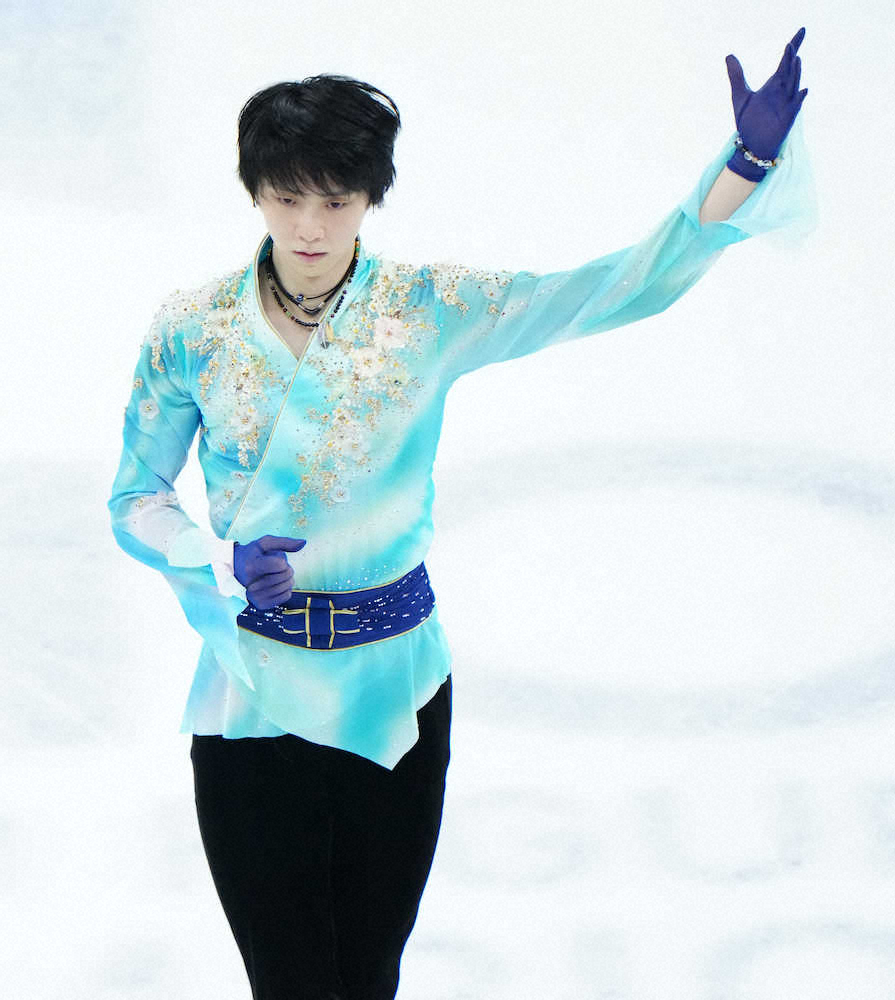
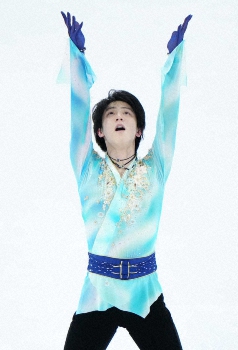
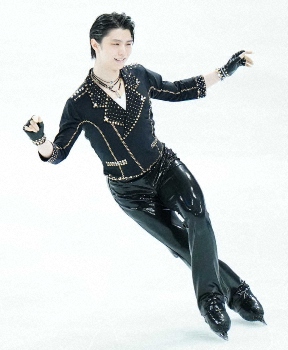
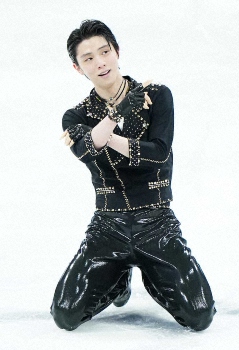

 Axel with Wings